
ASML Names the One Supplier That Limits Its Output
If ASML builds the most advanced chip-making machines, why does its own annual report say one outside supplier limits how many it can build?
Coming soon on YouTube.
In short
Advanced chips depend on these machines. A documented limit on how many can be built is therefore a documented limit on a key link in the chip supply chain.
Every fact on screen is quoted from or restated from the sources below; inferences are labelled. No wrongdoing is alleged.
On the record · 27 claims
-
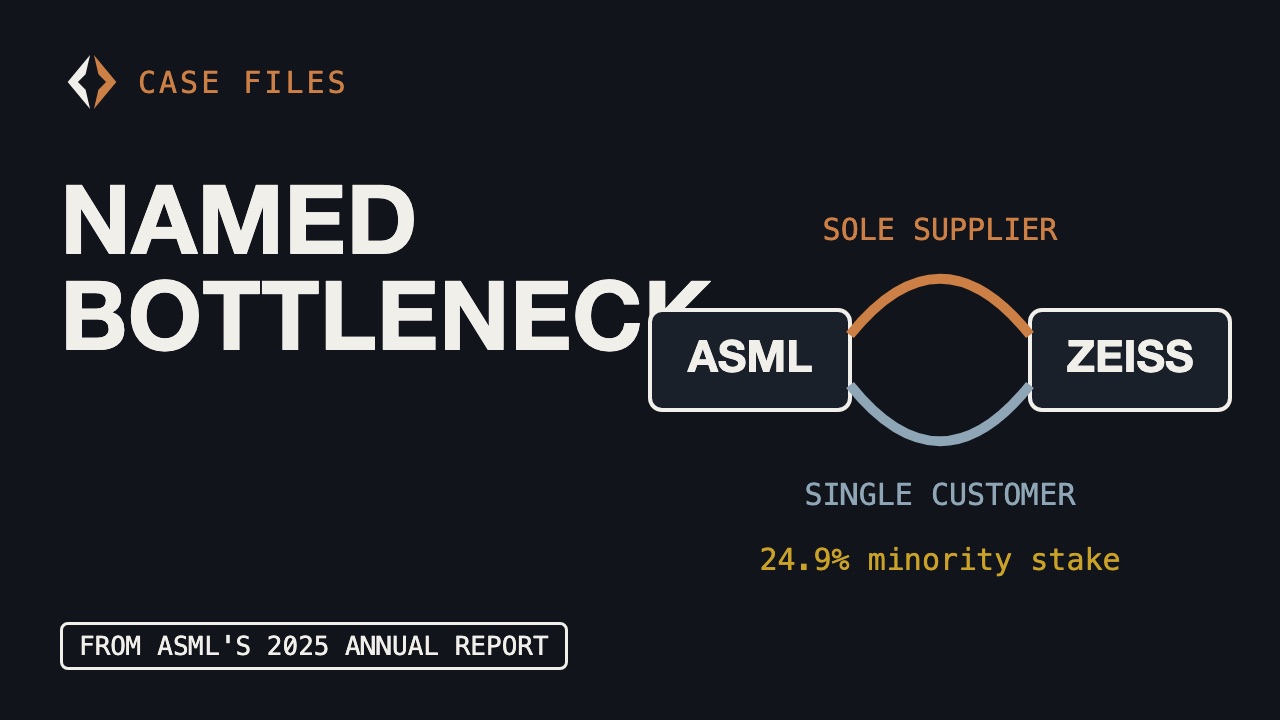
ASML says the number of lithography systems it can produce is limited by the production capacity of Carl Zeiss SMT. ASML calls Zeiss SMT its sole supplier of lenses, mirrors, illuminators, collectors and other critical optical components, which it refers to as optics.
“The number of lithography systems we are able to produce is limited by the production capacity of one of our key suppliers, Carl Zeiss SMT, our sole supplier of lenses, mirrors, illuminators, collectors and other critical optical components (which we refer to as optics).”
ASML Holding N.V. · ASML Annual Report 2025 (ESEF reporting package, IFRS) (2026-02-25; as of 2025-12-31)
-
ASML describes an exclusive arrangement with Carl Zeiss SMT. It says that if this supplier could not maintain and increase production, ASML could be unable to fulfil orders.
“We have an exclusive arrangement with Carl Zeiss SMT. If this supplier became unable to maintain and increase production levels, we could be unable to fulfill orders.”
ASML Holding N.V. · ASML Annual Report 2025 (ESEF reporting package, IFRS) (2026-02-25; as of 2025-12-31)
-
ASML states that if Carl Zeiss SMT ended supply or could not maintain optics production over a prolonged period, ASML would effectively be unable to conduct its business.
“Furthermore, if Carl Zeiss SMT were to terminate its supply relationship with us or be unable to maintain production of optics over a prolonged period, we would effectively cease to be able to conduct our business.”
ASML Holding N.V. · ASML Annual Report 2025 (ESEF reporting package, IFRS) (2026-02-25; as of 2025-12-31)
-
In its related-party note ASML says Carl Zeiss SMT GmbH is its single supplier of optical columns for lithography systems, and that ASML is Zeiss SMT GmbH's single customer for them.
“Carl Zeiss SMT GmbH is our single supplier, and we are their single customer, of optical columns for lithography systems.”
ASML Holding N.V. · ASML Annual Report 2025 (ESEF reporting package, IFRS) (2026-02-25; as of 2025-12-31)
-
ASML says Zeiss SMT GmbH can develop and produce these items only in limited numbers. It can do so only at its manufacturing and testing facilities in Oberkochen and Wetzlar, Germany.
“Carl Zeiss SMT GmbH is capable of developing and producing these items only in limited numbers and only through the use of manufacturing and testing facilities in Oberkochen and Wetzlar, Germany.”
ASML Holding N.V. · ASML Annual Report 2025 (ESEF reporting package, IFRS) (2026-02-25; as of 2025-12-31)
-
ASML describes the relationship as a strategic alliance run on the principle of 'two companies, one business'. It is focused on continuous innovation and operational excellence in the lithography business.
“Our relationship with Carl Zeiss SMT GmbH is structured as a strategic alliance that is run under the principle of 'two companies, one business' and is focused on continuous innovation and improvement of operational excellence in the lithography business.”
ASML Holding N.V. · ASML Annual Report 2025 (ESEF reporting package, IFRS) (2026-02-25; as of 2025-12-31)
-
ASML's investment in associates is a 24.9% equity interest acquired on June 29, 2017. It is held in Carl Zeiss SMT Holding GmbH & Co. KG, a limited partnership that owns Carl Zeiss SMT GmbH, ASML's single supplier of optical columns.
“Investments in associates consists of a 24.9% equity interest acquired on June 29, 2017 in Carl Zeiss SMT Holding GmbH & Co. KG, a limited partnership that owns Carl Zeiss SMT GmbH, our single supplier of optical columns.”
ASML Holding N.V. · ASML Annual Report 2025 (ESEF reporting package, IFRS) (2026-02-25; as of 2025-12-31)
-
ASML holds a 24.9% interest in Carl Zeiss SMT Holding GmbH & Co. KG, whose ultimate parent is Carl Zeiss AG. That entity owns 100% of Carl Zeiss SMT GmbH. ASML says it can exercise significant influence over the entity, so the entity and its subsidiaries are related parties.
“We have a 24.9% interest in Carl Zeiss SMT Holding GmbH & Co. KG (ultimate parent is Carl Zeiss AG), which owns 100% of the shares in Carl Zeiss SMT GmbH. As we are able to exercise significant influence over the entity, Carl Zeiss SMT Holding GmbH & Co. KG and its subsidiaries are considered related parties.”
ASML Holding N.V. · ASML Annual Report 2025 (ESEF reporting package, IFRS) (2026-02-25; as of 2025-12-31)
-
ASML says the holding entity is a variable interest entity (VIE) but that ASML is not its primary beneficiary. The reason it gives is that ASML lacks the power to direct the activities that most significantly affect the entity's economic performance.
“However, we are not the primary beneficiary of the VIE, because we lack the power to direct the activities that most significantly impact Carl Zeiss SMT Holding GmbH & Co. KG's economic performance.”
ASML Holding N.V. · ASML Annual Report 2025 (ESEF reporting package, IFRS) (2026-02-25; as of 2025-12-31)
-
ASML has had several framework agreements with Carl Zeiss SMT GmbH since 1997.
“We have had several framework agreements in place with Carl Zeiss SMT GmbH since 1997.”
ASML Holding N.V. · ASML Annual Report 2025 (ESEF reporting package, IFRS) (2026-02-25; as of 2025-12-31)
-
ASML entered into a framework agreement with Zeiss SMT GmbH in September 2021, effective from the beginning of 2021. It replaced the key existing framework agreements and continued the strategic alliance.
“We entered into a framework agreement in September 2021 with Carl Zeiss SMT GmbH, with effect as of the beginning of 2021. This agreement, which we refer to as the 2021 framework agreement, replaced our key existing framework agreements and continued our strategic alliance to meet end customer demand.”
ASML Holding N.V. · ASML Annual Report 2025 (ESEF reporting package, IFRS) (2026-02-25; as of 2025-12-31)
-
The financing runs through loan agreements. The loans have ten-year terms with linear annual repayment after a three-year grace period. The interest rate has a floor of 0.01% and a cap of 1%. The loans can be repaid voluntarily without penalty and are secured by a parental guarantee from Carl Zeiss AG.
“Ten-year loan terms with linear annual repayment after a three -year grace period • Interest rate subject to a floor of 0.01% and a cap of 1% • Voluntary repayment option without penalty • The loans are secured by a parental guarantee from Carl Zeiss AG”
ASML Holding N.V. · ASML Annual Report 2025 (ESEF reporting package, IFRS) (2026-02-25; as of 2025-12-31)
-
ASML's R&D funding to Zeiss SMT GmbH for High NA was €22.5 million in 2025, €45.1 million in 2024 and €67.6 million in 2023.
“For 2025, the related R&D funding amounted to €22.5 million (2024: €45.1 million; 2023: €67.6 million).”
ASML Holding N.V. · ASML Annual Report 2025 (ESEF reporting package, IFRS) (2026-02-25; as of 2025-12-31)
-
ASML makes advance payments to secure optical column deliveries. These payments are settled through future lens or optical column deliveries and appear in Other assets.
“These payments are made to secure optical column deliveries and these advance payments are settled through future lens or optical column deliveries, and are also presented in Other assets.”
ASML Holding N.V. · ASML Annual Report 2025 (ESEF reporting package, IFRS) (2026-02-25; as of 2025-12-31)
-
In September 2021 ASML signed a loan agreement with Zeiss SMT GmbH for up to €1 billion. By December 31, 2025 it had financed €839.1 million, against €912.4 million a year earlier.
“In September 2021, we entered into a loan agreement with Carl Zeiss SMT GmbH for up to €1 billion. As of December 31, 2025, we have financed a total amount of €839.1 million (December 31, 2024: €912.4 million) through this loan agreement.”
ASML Holding N.V. · ASML Annual Report 2025 (ESEF reporting package, IFRS) (2026-02-25; as of 2025-12-31)
-
In September 2024 ASML signed a second loan agreement with Zeiss SMT GmbH for up to €1 billion. At December 31, 2025 the drawn amount was €610.0 million, with an amortized cost of €527.1 million.
“In September 2024, we entered into a second loan agreement with Carl Zeiss SMT GmbH for up to €1 billion. As of December 31, 2025, the drawn down amount was €610.0 million with an amortized cost of €527.1 million”
ASML Holding N.V. · ASML Annual Report 2025 (ESEF reporting package, IFRS) (2026-02-25; as of 2025-12-31)
-
For 2025 ASML recorded a profit related to its investments in associates of €216.7 million, up from €209.8 million in 2024.
“For the year ended December 31, 2025, we recorded a profit related to investments of €216.7 million (2024: €209.8 million) in the Consolidated statement of profit or loss.”
ASML Holding N.V. · ASML Annual Report 2025 (ESEF reporting package, IFRS) (2026-02-25; as of 2025-12-31)
-
ASML says its sourcing strategy often follows the principle of "single sourcing, dual competence".
“In many cases, our sourcing strategy follows the principle of "single sourcing, dual competence".”
ASML Holding N.V. · ASML Annual Report 2025 (ESEF reporting package, IFRS) (2026-02-25; as of 2025-12-31)
-
ASML says many parts are single-sourced or come from a limited number of vendors. It says this is especially true for EUV systems, where multi-sourcing is often economically impractical.
“This is especially true for EUV systems, where the complexity and uniqueness of parts often make multi- sourcing economically impractical.”
ASML Holding N.V. · ASML Annual Report 2025 (ESEF reporting package, IFRS) (2026-02-25; as of 2025-12-31)
-
ASML says EUV has no lenses because most materials absorb EUV light. It developed an optical system of ultrasmooth multilayer mirrors inside a vacuum chamber.
“Since most materials absorb EUV light, the lenses would absorb the light in the system. Instead, we developed a brand-new optical system that uses ultrasmooth, multilayer mirrors inside a vacuum chamber.”
ASML · Lithography principles: lenses and mirrors (web page, undated; as of accessed 2026-11-22)
-
Each EUV mirror has over 100 layers of materials engineered to maximize the reflection of EUV light.
“Each mirror has over 100 layers of materials that were carefully chosen and precisely engineered to maximize the reflection of EUV light.”
ASML · Lithography principles: lenses and mirrors (web page, undated; as of accessed 2026-11-22)
-
ZEISS describes its EUV optical system as about 1.5 meters high and 3.5 tons in weight. It has over 35,000 individual parts.
“The system is approximately 1.5 meters high, weighs 3.5 tons, and comprises over 35,000 individual parts.”
ZEISS Semiconductor Manufacturing Technology · EUV lithography (web page, undated; as of accessed 2026-11-22)
-
ASML's EUV technology prints microchips using light with a wavelength of 13.5 nm.
“The technology, which is unique to ASML, prints microchips using light with a wavelength of just 13.5 nm - almost x-ray range.”
ASML · EUV lithography systems (web page, undated; as of accessed 2026-11-22)
-
ASML says all its lithography systems have featured optics from its strategic partner ZEISS since the late 1980s.
“Since the late 1980s, all our lithography systems have featured optics from our strategic partner ZEISS.”
ASML · Lithography principles: lenses and mirrors (web page, undated; as of accessed 2026-11-22)
-
ASML and Zeiss SMT are tied together both ways for optical columns. ASML says its output is capped by Zeiss SMT and that losing Zeiss SMT would end its business, and it also names itself as Zeiss SMT GmbH's single customer for that product. The passages quantify ASML's exposure but not Zeiss SMT's.
-
The 24.9% stake gives ASML significant influence and a share of profit, but ASML's own disclosure says it is not control. ASML says it lacks the power to direct the activities that most significantly affect the entity's economic performance and is not the primary beneficiary.
-
The supply limit rests on a small number of sites and a very complex product. Zeiss SMT can make optical columns only in limited numbers at two German sites, and its EUV optical system has tens of thousands of parts. This is consistent with ASML naming Zeiss SMT's capacity as the output limit. The passages do not show why capacity cannot be raised faster.
Sources
- ASML Holding N.V. ASML Annual Report 2025 (ESEF reporting package, IFRS) (2026-02-25; as of 2025-12-31)
- ASML Lithography principles: lenses and mirrors (web page, undated; as of accessed 2026-11-22)
- ASML EUV lithography systems (web page, undated; as of accessed 2026-11-22)
- ZEISS Semiconductor Manufacturing Technology EUV lithography (web page, undated; as of accessed 2026-11-22)
Transcript
Read the full narration (832 words)
0:00ASML builds the machines that make advanced chips. Its own annual report names one supplier as the limit on its output. That supplier also depends on ASML, its single customer for optical columns. Here is the sentence, from ASML's latest annual report. It says ASML's output is limited by the production capacity of Carl Zeiss SMT.
0:33ASML calls it the sole supplier of its optics. Read that again. It is a named limit. Start with the first direction. Zeiss SMT supplies ASML's optics. Now reverse it. For optical columns, ASML is Zeiss SMT's single customer. ASML also holds 24.9 percent of Zeiss SMT's parent holding, since 2017. It is a minority stake.
1:09The holding owns 100 percent of Zeiss SMT GmbH. ASML's filing calls it significant influence, not control. One reading: the dependency runs both ways, but unequally. This is a simplified schematic, not to scale. Light starts at the EUV light source. ASML says its EUV technology prints chips with light of 13.5 nanometers wavelength. Next come the collector and illuminator mirrors.
1:46ASML says EUV has no lenses, because most materials absorb this light. So ASML developed an optical system of ultrasmooth multilayer mirrors inside a vacuum chamber. The light then reaches the mask, the next stage on our schematic. Projection mirrors come next. Each mirror has over 100 layers, engineered to reflect EUV light. Finally the light reaches the wafer.
2:18According to ZEISS, the optical system is about 1.5 meters high, weighs 3.5 tons, and has over 35,000 parts. Why not simply add a second supplier? ASML's annual report answers. It says the complexity and uniqueness of parts often make multi-sourcing economically impractical. That is especially true, ASML says, for EUV systems. ASML also says its sourcing often follows a principle it calls single sourcing, dual competence.
2:58Our timeline starts in the late 1980s. ASML says all its systems have featured optics from ZEISS since then. That strengthened the tie. In 1997 came framework agreements, which formalized the relationship. ASML says there have been several since. In 2017 ASML acquired its 24.9 percent stake. That strengthened the link, without giving control. In 2021 a new framework agreement replaced the key earlier ones and continued the strategic alliance. It formalized the terms again.
3:40In 2024 ASML signed a second loan agreement of up to €1 billion. The drawn amount at year-end was 610, in millions of euros. One reading is that this mitigates the dependency, since ASML also makes advance payments to secure optical column deliveries. Now the money. ASML's filing reports a 24.9 percent interest, acquired in 2017.
4:12For the latest year it recorded a profit related to its associates of €216.7 million, up from 209.8 million a year earlier. Under the 2021 loan agreement, worth up to 1 billion euros, ASML had financed €839.1 million by year-end. Under the 2024 agreement, also up to 1 billion euros, the drawn amount was 610, in millions of euros.
4:45The loans carry an interest floor of 0.01 percent and a cap of 1 percent, with a parental guarantee from Carl Zeiss AG. But ASML's accounting says significant influence, not control. It is not the primary beneficiary of the VIE, a variable interest entity. What does the stake not give ASML? Its own report answers.
5:15ASML says it is not the primary beneficiary of the VIE, because it lacks the power to direct the activities. Those are the activities that most significantly affect the entity's economic performance. One reading is that the stake is a financial link and a source of influence, not a steering wheel. Here are two fair readings. First, dependency risk.
5:43ASML says it would effectively be unable to conduct its business if supply ended. Its output is limited by Zeiss SMT's capacity, and ASML says it could be unable to fulfil orders. Second, a managed alliance: agreements since 1997, a stake, two loans of up to 1 billion euros each, and advance payments. One reading is that both companies work to manage the link.
6:17Now, what is not proven. The passages quantify ASML's exposure, not Zeiss SMT's. They do not say why capacity cannot be raised faster, or whether the loans or stake give ASML any say over Zeiss SMT's operations. Nor do they speak to market power beyond optical columns for lithography systems. So, the opening question. Why does ASML's report name a supplier as its limit?
6:52Known: ASML says Zeiss SMT's capacity limits its output, and it is Zeiss SMT GmbH's single customer for optical columns. Its 24.9 percent stake is not control. Inferred: a few sites and a product with over 35,000 parts, according to ZEISS, are consistent with that named limit. Unresolved: how much Zeiss SMT depends on ASML, and why its capacity cannot grow faster.
7:29Evidence on Zeiss SMT's own exposure, or on any say over capacity, would change the verdict. We revisit when ASML's next annual report updates the loans. Next Case File: how the ten-year loans repay after a three-year grace period.
Corrections
None. If a fact in this film changes, the correction will be dated and shown here.
Season 3 · The Bottlenecks
More from this season
Who Makes the Mirrors Inside ASML's Chip Machines?
The chips in everyday devices are printed by these machines. By ASML's own account, how many machines it can build depends on one optics maker's capacity.