
Does One Fictional AI Server Ever Pay Back?
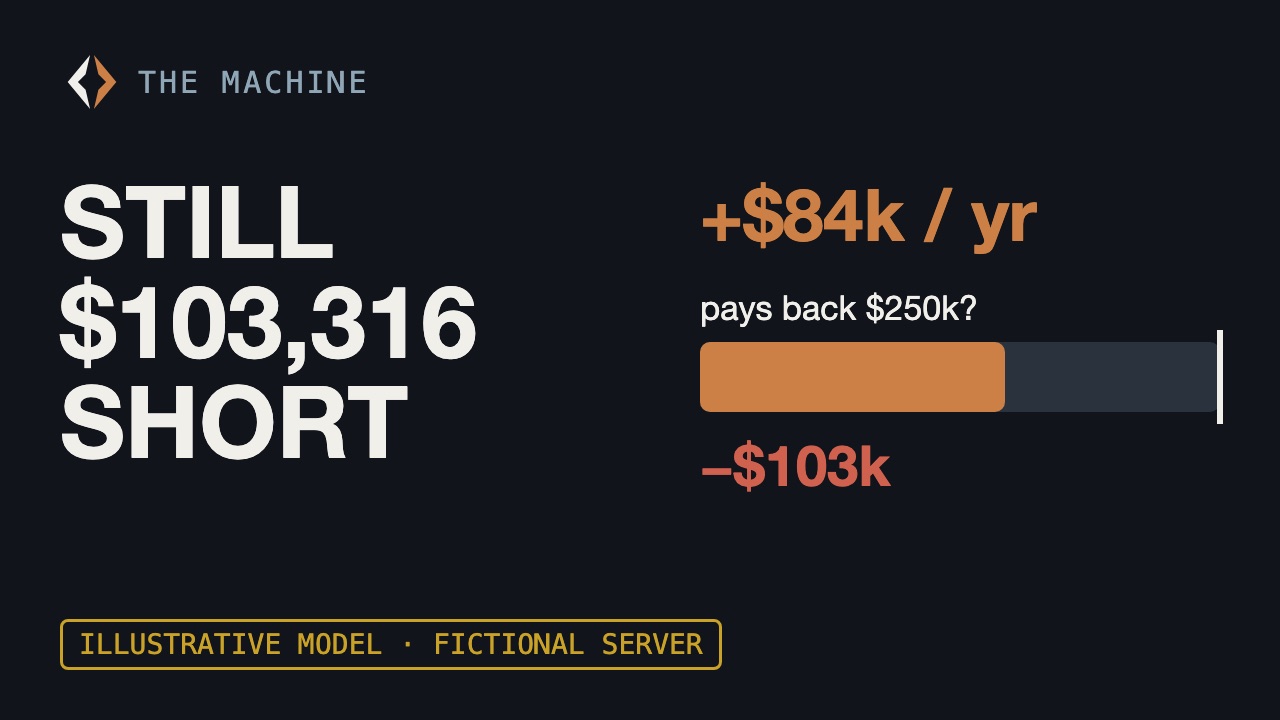
If a fictional AI server turns about $84,000 of operating cash each year for five years, why might it never earn back its $250,000 price?
Coming soon on YouTube.
In short
Anyone who sees a large yearly cash figure next to a big purchase price can make the same mistake. The yearly flow and the recovery of the purchase are two different questions.
FICTIONAL TEACHING EXAMPLE: one illustrative eight-GPU server and a transparent, deterministic model. Every input is an assumption chosen for teaching — not a market average — and every result is a model output, not a prediction or investment advice.
Assumptions and method
Inputs (all ASSUMPTION)
- I_GPUS gpu_count = 8 count — One 8-GPU rental server.
- I_HOURS hours_per_year = 8760 hours — 365 × 24.
- I_UTIL utilization = 0.7 fraction — Share of GPU-hours customers actually pay for.
- I_PRICE rental_price = 2.5 USD/GPU-hour — Illustrative rental price.
- I_PEAK_KW peak_kw = 10 kW — Whole-server draw at full load (illustrative).
- I_IDLE_KW idle_kw = 2 kW — Whole-server draw when idle (illustrative).
- I_PUE pue = 1.3 ratio — Facility overhead: cooling and power conversion per unit of IT power.
- I_ELEC electricity_price = 0.1 USD/kWh — Illustrative industrial electricity price.
- I_OPEX non_energy_cash_costs = 30000 USD/year — Space, network, staff share, support — excluding electricity.
- I_CAPEX capex = 250000 USD — Purchase price of the server.
- I_LIFE useful_life_years = 5 years — Years the server is rented before it is obsolete (illustrative).
Formula registry
- FR_AVAILABLE available_gpu_hours = gpu_count × hours_per_year (GPU-hours / year)
- FR_SOLD sold_gpu_hours = available_gpu_hours × utilization (GPU-hours / year)
- FR_REVENUE rental_revenue = sold_gpu_hours × rental_price (USD / year)
- FR_AVG_KW average_IT_power = idle_kW + (peak_kW − idle_kW) × utilization (kW)
- FR_KWH facility_energy = average_IT_power × hours_per_year × PUE (kWh / year)
- FR_ELEC electricity_cost = facility_energy × electricity_price (USD / year)
- FR_SURPLUS operating_cash_surplus = rental_revenue − electricity_cost − non_energy_cash_costs (USD / year)
- FR_PAYBACK simple_payback = capex ÷ surplus (undefined if surplus ≤ 0; assumes a constant surplus) (years)
- FR_BREAK_EVEN break_even_utilization = fixed ÷ (rev_coef − elec_coef) (none if ≤ 0 or > 1) (fraction)
- FR_LIFETIME year-y price = price × (1 + annual_change)^(y−1), rounded to cents; cumulative surplus compared with capex over useful_life_years (USD)
Exclusions
depreciation_accounting, taxes, financing_costs, replacement_capex, receivables_and_payment_delays, working_capital, maintenance_and_failures, resale_value
Transcript
Read the full narration (982 words)
0:00This is a fictional teaching example: one imaginary AI server, priced at $250,000. In year one, it produces about $84,000 of operating cash. It lasts five years. That should be plenty of time to pay itself back. Yet under one assumption, it ends $103,316 short of its price. How? Businesses everywhere buy equipment this way, so the trap matters to anyone.
0:35Meet the machine: eight GPUs in one box, rented to customers by the hour. It draws electricity, and all that power turns into heat, so it needs cooling. Every number here is an assumption chosen for teaching, not a market average. Nothing here is measured. Three numbers, and we will keep them apart. First, revenue: what customers pay.
1:03Second, operating cash: what is left each year after running costs. Third, capital recovery: whether the $250,000 purchase ever comes back. By the end, you will see the hidden clock that decides the third. Start with capacity. Eight GPUs, times 8,760 hours in a year, gives 70,080 GPU-hours available. A GPU-hour is one GPU working for one hour.
1:36It is a unit of service, not of energy. Now assume customers rent 70 percent of that time. Utilization is the name for that share of hours actually rented. That is 49,056 billable GPU-hours per year. The other 21,024 sit idle, unsold. Remember this unit. Everything about revenue comes from these hours. Now the payments. Each billable GPU-hour pays $2.50.
2:10Multiply 49,056 billable hours by $2.50, and customers pay $122,640 per year. That is revenue: all the money coming in each year. It is money in, not money kept. Nothing has been paid out yet. Revenue says how busy customers keep the machine, not how well the owner does. Running the machine costs money too. Next, we follow the first cost: energy.
2:45Energy is a separate stream, with its own unit. At 70 percent load, the server draws about 7.6 kilowatts on average. That sits between two kilowatts idle and ten at full load. Cooling and power conversion add 30 percent on top. Engineers call that a PUE of 1.3. Run that all year and you use about 86,549 kilowatt-hours.
3:17A kilowatt-hour is one kilowatt running for one hour. At 10 cents each, the electricity bill is $8,655 per year. Kilowatt-hours measure energy. GPU-hours measure service. Never add them together. Now follow one year of revenue. Start with $122,640 per year coming in. Remove electricity: $8,655 per year. Remove the other running costs, like space, network and support: $30,000 per year.
3:59What is left is the modeled operating cash: $83,985 per year. Operating cash is the cash left after the bills for running the machine are paid. In this example, electricity is about 7 percent of revenue. That is a property of these assumptions, not a rule. Change the inputs, and the share changes. Now a warning. The $83,985 is not profit.
4:33Net profit is not modeled here at all. The model leaves out depreciation, taxes, financing, replacement parts, late-paying customers and working capital. Depreciation means the machine losing value as it ages. Working capital means cash tied up in day-to-day operations. This number is cash from operating the machine for one year. Nothing more. Treat it as a clean, simple measuring stick, not a verdict on the owner's finances.
5:08Now capital recovery. Buying the machine puts you $250,000 below zero. Each year adds $83,985 of operating cash, one step at a time. Cumulative means the running total, so each step builds on the last. The line crosses zero after about 2.98 years. That is the simple payback. Simple payback assumes the same operating cash every year.
5:42In that world, the machine is earned back in year three, well inside its five-year life. Keep that zero line in mind. It is the finish line for the rest of this episode. Here is the hidden clock. Assume the rental price falls 30 percent every year. That is an assumption, not a claim about any real market.
6:05Same machine, same hours. Year one still rents at $2.50. Year two, $1.75. Then $1.22, $0.86, and $0.60 in year five. The money stream thins. Operating cash falls from $83,985 in year one to $47,193 in year two. Year three, $21,193. Year four, just $3,533. In year five, the server takes in less than it costs to run: minus $9,221.
6:54Now the five-year race against the $250,000, on one chart. With flat prices, it is recovered in year three. After five years, cumulative cash is $169,926 ahead of the price. If prices fall 15 percent a year, recovery comes only in year five, with $11,965 ahead after five years. At 30 percent a year, recovery climbs, stalls in year four, then slips back.
7:34It ends $103,316 short. Same machine, same hours, same costs. Only the price path changed. Earning cash is not the same as recovering the purchase.
7:48What moves annual operating cash most, in this model? Utilization from 50 to 90 percent swings it from $50,767 to $117,203 per year. Rental price from $2 to $3 swings it from $59,457 to $108,513 per year. Electricity from 5 to 20 cents per kilowatt-hour moves it only from $88,313 to $75,330 per year. Around the $83,985 base, electricity still matters.
8:38It just moves less, with these assumptions. But none of this says whether the cash ever repays the machine. The clock decides that. So, the answer. Operating cash is a yearly flow. Recovering the machine is a race against the clock. If the price falls fast enough, the flow dries up before the $250,000 is earned back.
9:05In our example, that leaves $103,316 unrecovered after five years. Known: the arithmetic. Assumed: every input. Modeled: every result. Inferred: timing can matter as much as size. One honest open question: what is left of the server's value after five years? Next time: what is it still worth, and could resale change the race?
Corrections
None. If a fact in this film changes, the correction will be dated and shown here.
Season 2 · Follow the Money
Up next
Can a Fictional AI Data Center Survive a Shock?
Any business that cuts prices to win back customers is betting on how strongly customers respond. That response is the one input nobody can observe in advance.
What Happens When a Rival Can Answer Your Price Cut?
Any price cut is a move against someone who can respond. The cut can look like a clear win until the other side answers, and you only learn how they respond after you have committed.
What Happens When a Rival Can See Your Cash?
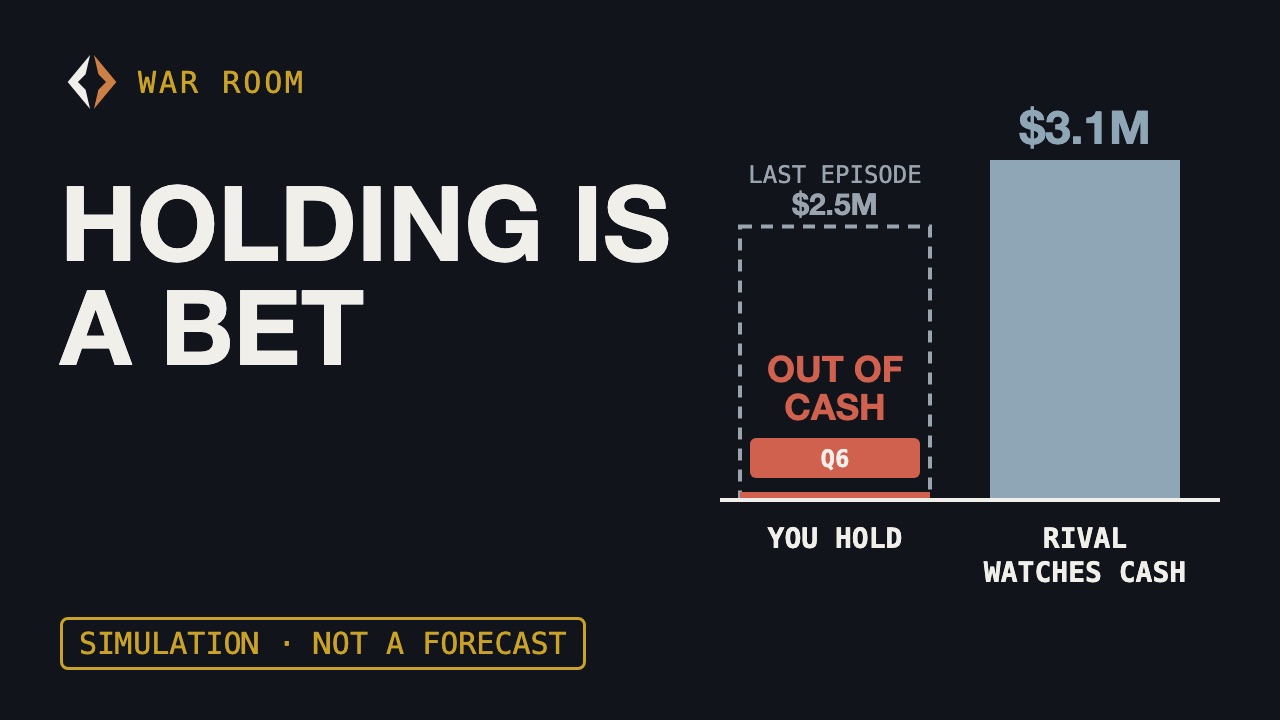
A habit that looked safe can stop being safe once someone else can see your weak point. This model shows that change on a small board, with rules anyone can check.