
What Happens When a Rival Can See Your Cash?
If a rival can see your cash, is holding your price still the safe choice?
Coming soon on YouTube.
In short
A habit that looked safe can stop being safe once someone else can see your weak point. This model shows that change on a small board, with rules anyone can check.
This is a TWO-PLAYER SIMULATION of FICTIONAL operators in which the rival can see your cash. Every input and every behaviour is an explicit, declared assumption, and every result is a simulated outcome of a transparent, deterministic model — not a forecast, not a probability, not a statement about how any real company competes.
Assumptions and method
Formula registry
- FR_MARKET market_hours = base_market_demand × shock_t × (average_price / ref_price)^(−market_elasticity) (GPU-hours per quarter)
- FR_SHARE target_share_you = p_you^(−σ) / (p_you^(−σ) + p_rival^(−σ)); share_you = share_prev + switch_speed × (target − share_prev) (fraction)
- FR_SOLD sold_i = min(market_hours × share_i, gpu_count_i × hours_per_quarter) (GPU-hours)
- FR_REVENUE revenue_i = sold_i × price_i (USD per quarter)
- FR_CASH cash_delta_i = revenue_i − fixed_i − variable_full_i × utilization_i − debt_i × rate_i / 4 − principal_i (USD per quarter)
- FR_TIMING both prices for quarter t are chosen from quarter t−1 information; a reaction lands one quarter after the move it answers (—)
- FR_STOP the board stops for BOTH players after the first quarter in which either closing cash < 0 (modeled funding shortfall); what happens next is outside the model (—)
Assumptions (all ASSUMPTION, none calibrated to real data)
- A_FLEET
operators— Two fictional mid-size GPU clouds, identical on purpose (a mirror-image rival) so only behaviour differs. - A_LIQUIDITY
operators.you.opening_cash_usd— Same as the pilot episode: holding ends near the funding edge within six quarters. - A_FINANCING
operators.you.opening_debt_usd— Debt-financed fleets; interest and scheduled principal make fixed obligations explicit. - A_PRICE
market.baseline_price_usd_per_gpu_hour— Illustrative rental price; both start at $3.00. - A_REFPRICE
market.reference_price_usd_per_gpu_hour— Demand curve anchor. - A_DEMAND
market.baseline_market_demand_gpu_hours— Pre-shock demand fills 80% of both fleets. - A_SHOCK
market.post_shock_demand_multiplier— Hypothetical event: market demand falls 40% from quarter 2 (same as the pilot). - A_SHOCKTIME
market.shock_period— One normal quarter establishes the baseline. - A_MARKET_E
market.market_elasticity— Unknown in reality. Chosen so that, against a rival that never reacts, a cut sees the same customer response as the pilot's central case. - A_SWITCH
market.switching_sensitivity— Unknown in reality; swept 1.5–4.0. NOT an estimate. - A_SPEED
market.switch_speed— Simplification: customers move within the quarter; contracts that slow switching are left out. - A_SHARE0
market.opening_share_you— Equal start: same price, same fleet, half the market each. - A_BOUNDS
market.price_bounds— Either operator may price between $1.50 and $4.00 per GPU-hour. - A_STEP
rules.max_price_change_per_period_usd— Contracts limit repricing to $0.75 per quarter. - A_VISIBLE
behaviours.rival— New in this episode: the rival sees your closing cash at the end of every quarter. How a real rival would see it is not modeled. - A_THRESHOLD
behaviours.rival.threshold_usd— Unknown in reality; the cash level at which the watching rival strikes. Central $15M, swept $8M–$24M. NOT an estimate. - A_TIMING
rules— Both set prices at the same time from last quarter's information, so any answer lands one quarter after the move.
Exclusions
taxes, receivables / payment delays, depreciation, working capital, refinancing, new capacity, cost cutting, collusion or signalling, non-price competition, contract stickiness (switch_speed = 1), what happens after a funding shortfall, learning: rules never change during the game
Stylized two-player liquidity model: no taxes, receivables, depreciation, working capital, refinancing, new capacity, cost cutting, collusion, signalling or non-price competition. You cannot hide or dress up your cash, and the rival cannot see anything else (no forecasts, no plans). The board stops for both at the first modeled funding shortfall; what happens next is outside the model.
Transcript
Read the full narration (957 words)
0:00This simulation has two fictional operators in one hypothetical market. Demand drops 40 percent. If you held at $3.00, cash drains. It ends at $2.5 million: safe, but only against price-reacting rivals. Now the rival sees your cash.
0:21Hold at $3.00. Cut 20 percent, to $2.40. Or match the rival's price. It sees your cash. Its rule is unknown. Which would you choose?
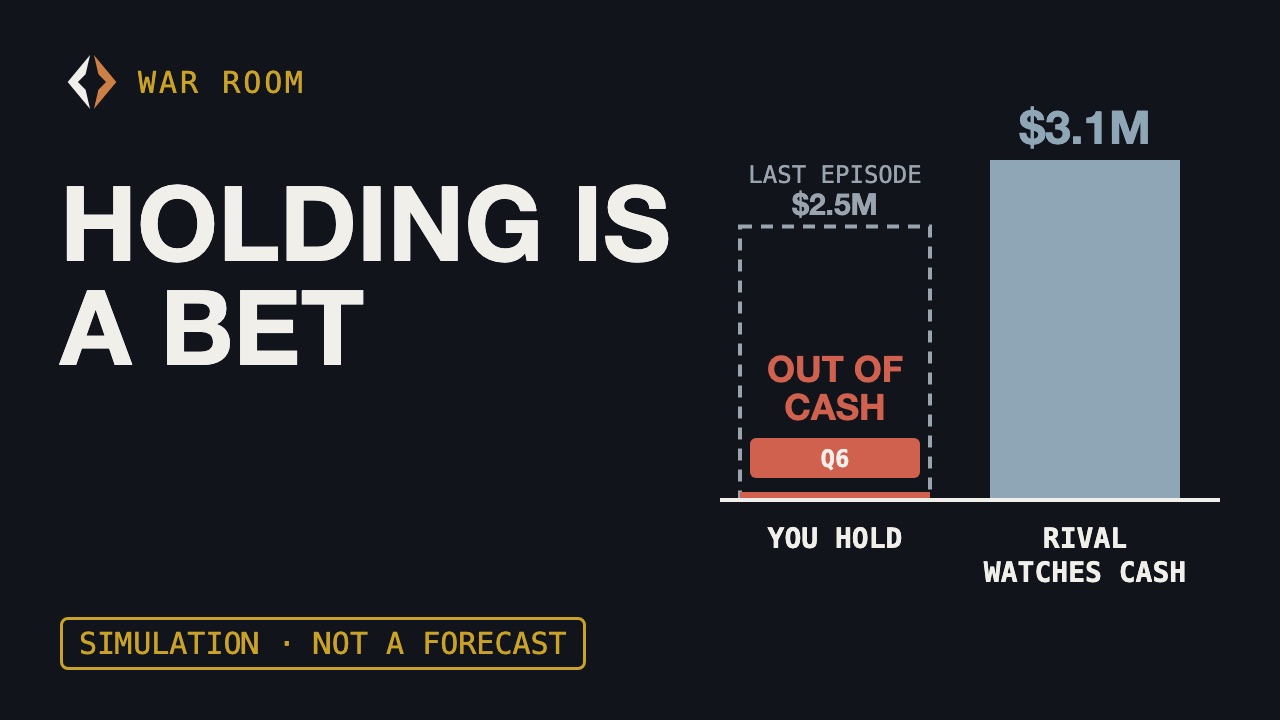
0:38You hold. Through Q4, nothing differs. Then your cash falls below $15 million. In Q5 it prices at $2.80, 20 cents below you. In Q6 it cuts again, to $2.60. You run out. Narrow: $0.2 million short; it keeps $3.1 million. Cutting first does not help. A passive rival never answers. This one does, below your price.
1:10Both run out of cash in Q6. The board: three choices, two rivals. Only matching gets through the watcher, with $0.2 million. War Room: a simulation, not a forecast. The board is the same as last episode. Both operators share one market. When the average price falls, the market grows a little. Elasticity, 0.5 here, sets how much.
1:39Customers move toward the cheaper operator. Switching sensitivity, 3.0 here and fixed this time, sets how strongly. Each operator follows the same cash rules. Both set prices at the same time, from last quarter's information, so any answer lands one quarter later. The board stops when either operator runs out of cash. Deterministic Python rules decide everything; no AI decides any outcome.
2:11Everything here is an assumption. Two identical operators, each with 4,000 GPUs, the chips they rent out, $26 million in cash and $150 million in debt. Assumption: demand drops 40 percent from Q2. Assumption: switching sensitivity is 3.0. Two more are new assumptions: the rival sees your closing cash every quarter, and it strikes once that cash is below $15 million.
2:44That threshold is not an estimate. We sweep it from $8 million to $24 million later. These rules are declared in advance and fixed all game. They are choices for the test, not claims about any real company. The rival is passive: it never changes its price. Or it watches your cash. Once your cash is below $15 million, it prices 20 cents below the lower of the two prices, one quarter later.
3:15You can hold, which keeps $3.00. Or cut to $2.40 once utilization, the share of GPUs in use, falls below 70 percent. Or match, which copies the rival's last price, one quarter later. Prices can move at most $0.75 a quarter. Replay: you hold, the rival watches. In Q1 nothing unusual happens. In Q2 the shock hits.
3:44Each operator's cash falls by about $5.1 million. Q3 is the same: identical books, identical losses. At the end of Q4, your cash is $12.3 million. That is below the $15 million line. In Q5 the rival prices at $2.80. In Q6 it prices at $2.60, and your market share falls to 39 percent. You run out of cash, $0.2 million short, a narrow margin.
4:18The rival ends with $3.1 million, above the $2.5 million it would have kept by holding. Here is every cell, with both cash figures when the board stops. Against the passive rival, nothing is new. Holding and matching both end near $2.5 million each. Your cut ends with $8.3 million, and the rival runs out of cash in Q5.
4:46Against the watcher, holding runs you out of cash in Q6: minus $0.2 million, while it keeps $3.1 million. Cutting runs both out: you at minus $2.5 million, the rival at minus $6.1 million. Only matching gets through, with $0.2 million left for you and $2.4 million for the rival. That is almost nothing. Now the assumption nobody can observe: when does the watcher strike?
5:19We sweep its threshold from $8 million to $24 million. If its threshold is $12 million or lower, it strikes too late. Holding gets you through with $1.6 million. From $15 million up, holding runs you out of cash at every level tested. Matching also gets through at $12 million or lower. At $15 million it still does, with $0.2 million left, a narrow margin.
5:49From $18 million up, matching runs you out too. At $24 million the watcher itself ends with almost no cash. At $12 million or lower, your cut runs the rival out first. From $15 million up, it runs both out. This is a range of assumptions, nothing more. Robust: against a rival that cannot see your cash, nothing changes from last episode.
6:17Also robust: against the watcher, cutting runs both out of cash from a $15 million threshold up. What flips: whether holding is safe depends on when the rival strikes. Matching gets through only against a later strike, and at $15 million with almost no cash left. Data needed: what a real rival can see of your cash, and when; how real rivals choose the moment; how readily real customers switch.
6:49This board leaves out a lot. You cannot hide your cash or raise more. Rules never change mid-game. There is no collusion, no signalling, and no contract that slows switching. Nothing is modeled after a funding shortfall. It cannot tell you what any real company would do, or how real rivals read a competitor's cash.
7:12It also cannot measure how often any outcome would occur. In this model, once the rival can see your cash, holding stops being the safe default. It becomes a bet on when the rival strikes, and you only learn that when it does. Known: the rules of the board. Assumed: every input and every behaviour.
7:35Simulated: every outcome. The open question is the moment of the strike. The model can only sweep it. Next time: what changes if you can see the rival's cash too?
Corrections
None. If a fact in this film changes, the correction will be dated and shown here.
Season 2 · Follow the Money
Up next
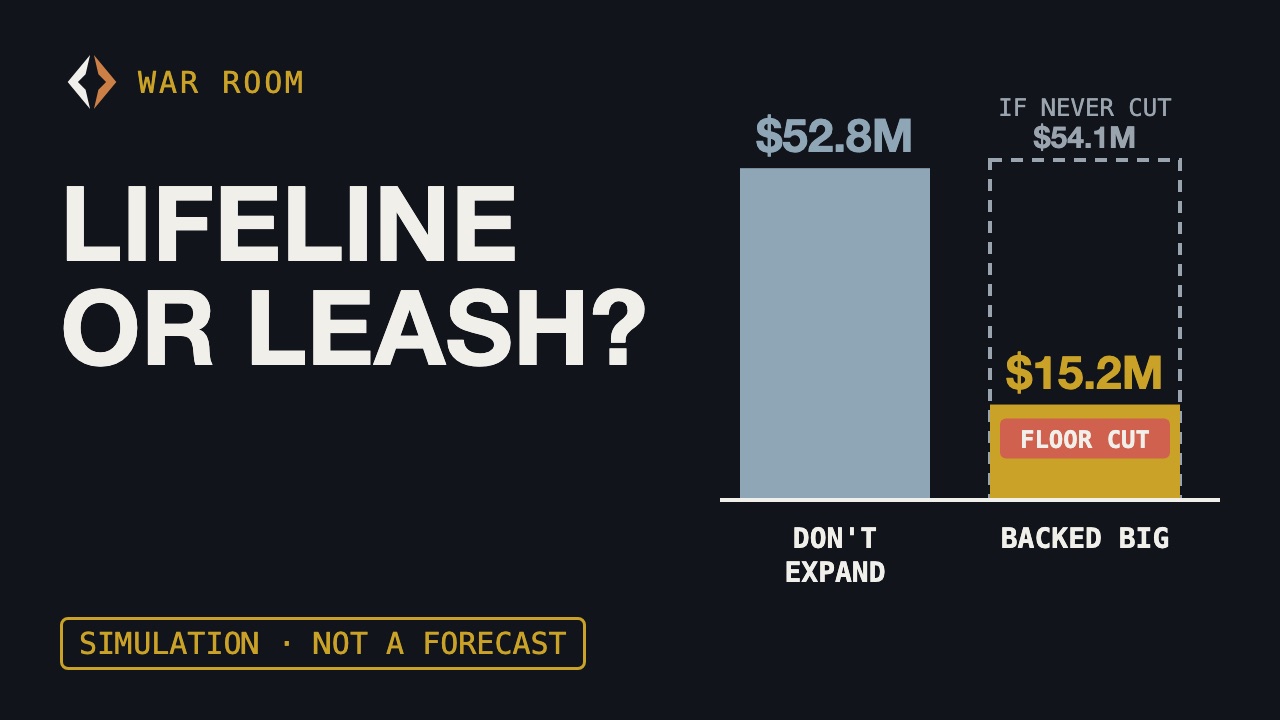
Lifeline or Leash? A War Room Simulation of Chip Backstops
GPU cloud companies borrow heavily to buy chips. If the lender and the supplier are tied together, the terms of that support decide who is exposed when demand drops.
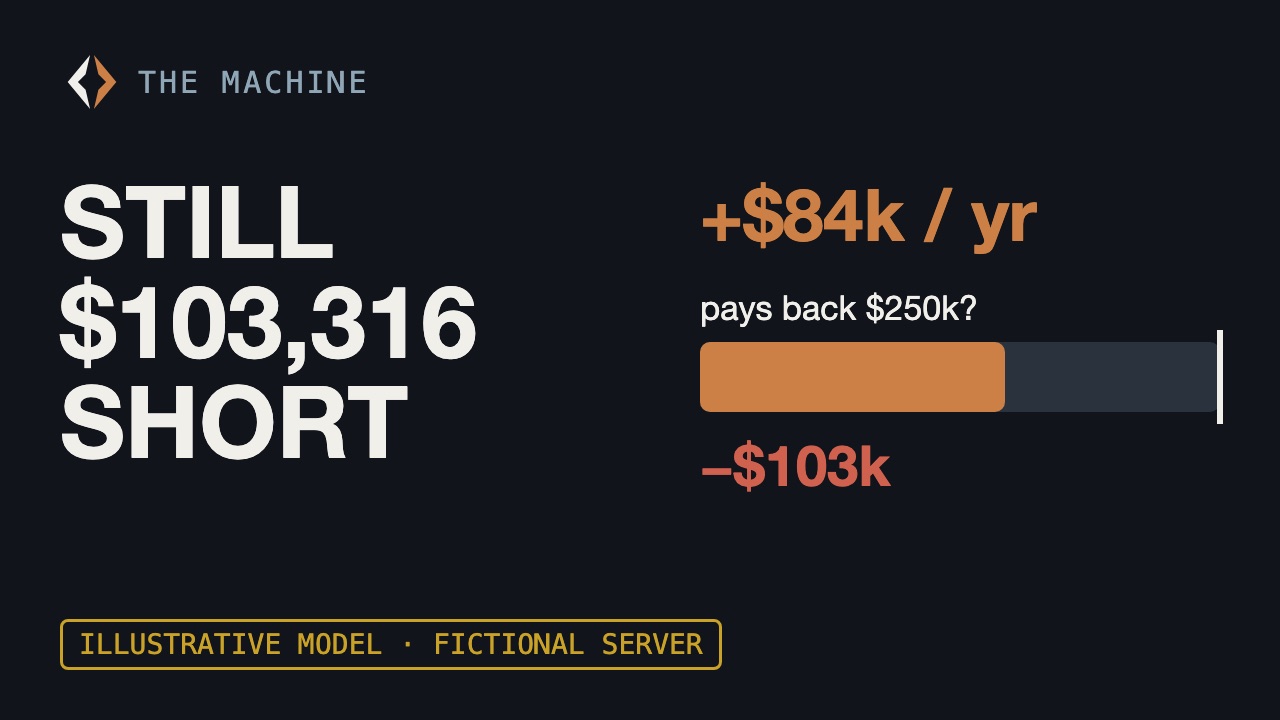
Does One Fictional AI Server Ever Pay Back?
Anyone who sees a large yearly cash figure next to a big purchase price can make the same mistake. The yearly flow and the recovery of the purchase are two different questions.
Can a Fictional AI Data Center Survive a Shock?
Any business that cuts prices to win back customers is betting on how strongly customers respond. That response is the one input nobody can observe in advance.