
Lifeline or Leash? A War Room Simulation of Chip Backstops
When your chip supplier backs your loans, is that a lifeline or a leash?
Coming soon on YouTube.
In short
GPU cloud companies borrow heavily to buy chips. If the lender and the supplier are tied together, the terms of that support decide who is exposed when demand drops.
Real-world context comes only from NVIDIA's own CFO commentaries (fiscal 2027, Q2 and Q3), quoted and cited. The SIMULATION is of a FICTIONAL GPU cloud with a STYLISED supplier backstop invented for the test: every input is an explicit assumption and every result is a simulated outcome of a transparent, deterministic model — not a forecast, not a probability, not a description of any real contract or company.
Sources
- NVIDIA Corporation CFO Commentary on Third Quarter Fiscal 2027 Results (as of 2026-10-25)
- NVIDIA Corporation CFO Commentary on Second Quarter Fiscal 2027 Results (as of 2026-07-26)
Assumptions and method
Formula registry
- FR_MARKET market_hours = base_market_demand × shock_t × (average_price / ref_price)^(−market_elasticity) (GPU-hours per quarter)
- FR_SHARE target_share_you = p_you^(−σ) / (p_you^(−σ) + p_rival^(−σ)); share_you = share_prev + switch_speed × (target − share_prev) (fraction)
- FR_SOLD sold_i = min(market_hours × share_i, gpu_count_i × hours_per_quarter) (GPU-hours)
- FR_REVENUE revenue_i = sold_i × price_i (USD per quarter)
- FR_CASH cash_delta_i = revenue_i − fixed_i − variable_full_i × utilization_i − debt_i × rate_i / 4 − principal_i (USD per quarter)
- FR_TIMING both prices for quarter t are chosen from quarter t−1 information; a reaction lands one quarter after the move it answers (—)
- FR_STOP the board stops for BOTH players after the first quarter in which either closing cash < 0 (modeled funding shortfall); what happens next is outside the model (—)
- FR_RATE rate_i(t) = backed rate; after an ACTUAL trim (fraction < 1) rate_after_trim; unbacked debt follows its rate_schedule (credit tightening from the shock) (annual)
- FR_BACKSTOP floor_t = floor × (trim_to_fraction if t ≥ trim_period else 1); top_up = max(0, floor_t − revenue); share_paid = upside_share × max(0, revenue − floor_t); cash_delta += top_up − share_paid (USD per quarter)
Assumptions (all ASSUMPTION, none calibrated to real data)
- A_FLEET
operators— Two fictional mid-size GPU clouds with 4,000 GPUs each (the same fleets as earlier episodes). You may expand; the rival does not. - A_LIQUIDITY
operators.you.opening_cash_usd— $26M opening cash, as in earlier episodes. - A_FINANCING
operators.you.opening_debt_usd— $150M existing debt at 9%, as in earlier episodes. - A_PRICE
market.baseline_price_usd_per_gpu_hour— Illustrative rental price; both hold $3.00 every quarter. - A_REFPRICE
market.reference_price_usd_per_gpu_hour— Demand curve anchor. - A_DEMAND
market.baseline_market_demand_gpu_hours— A boom: before the shock, demand exceeds what both fleets can serve, even after you expand. NOT an estimate of any real market. - A_SHOCK
market.post_shock_demand_multiplier— Hypothetical event: market demand falls 55% from quarter 4. - A_SHOCKTIME
market.shock_period— Three boom quarters, then the shock. - A_MARKET_E
market.market_elasticity— As in earlier episodes; prices never move here, so it has no effect. - A_SWITCH
market.switching_sensitivity— As in earlier episodes; equal prices keep shares at half each. - A_SPEED
market.switch_speed— Customers move within the quarter. - A_SHARE0
market.opening_share_you— Equal start. - A_BOUNDS
market.price_bounds— Unused here (no price moves). - A_STEP
rules.max_price_change_per_period_usd— Unused here (no price moves). - A_EXPANSION
operators.you.gpu_count— Expansion costs $30,000 per added GPU, all debt-financed (2,000 GPUs = $60M; 3,000 = $90M). Running costs scale with the fleet. NOT a real price. - A_BANKRATE
rate_schedule— Unbacked new debt costs 10%, and the whole loan re-prices to 14% when the shock hits (credit tightens). NOT a real rate. - A_BACKEDRATE
backstop— With the supplier's backing, lenders charge 8%. NOT a real rate. - A_FLOOR
backstop.floor_revenue_per_period_usd— The supplier tops quarterly revenue up to a floor ($30M for the big build, $24M for the cautious one): a stylised minimum commitment. NOT any real company's terms. - A_UPSIDE
backstop.revenue_share_above_floor— The supplier takes 20% of revenue above the floor. The size is an assumption; that such revenue shares exist is documented in the context sources, but not at what rate. - A_TRIM
backstop.trim_period— Central case: from quarter 6 the floor is cut to half (backstop.trim_to_fraction 0.5). Swept: every quarter 4–8 × keep 0–100%. NOT a prediction. - A_TRIMRATE
backstop.rate_after_trim— Once the floor is actually cut, the debt re-prices to the unbacked 14%.
Exclusions
taxes, receivables / payment delays, depreciation, working capital, refinancing, renegotiating the backstop, cost cutting, price moves (both hold $3.00), what happens after a funding shortfall, any real company's actual contract terms
Stylized two-player liquidity model with a stylised supplier backstop: no taxes, receivables, depreciation, working capital, refinancing, renegotiation, cost cutting, collusion, signalling or non-price competition. Expansion is bought before quarter 1. The board stops for both at the first modeled funding shortfall; what happens next is outside the model. The backstop is not NVIDIA's (or anyone's) actual contract.
Transcript
Read the full narration (848 words)
0:00NVIDIA says many neoclouds, GPU cloud companies, grow faster than their balance sheets support. It has arrangements that help select customers. When your chip supplier backs you: lifeline or leash? NVIDIA says commitments take effect only if financing is secured and capacity accepted. Otherwise, it says, commitments could be reduced or eliminated. One line was $36 billion, then $32 billion under a new name.
0:33The documents do not say why. Let's start a simulation now.
0:40A fictional GPU cloud, 4,000 GPUs, with a fictional backstop. Either don't expand, or a bank loan: 2,000 more GPUs. Or backed big: 3,000 more, supplier-backed. Or backed cautious. Which would you choose?
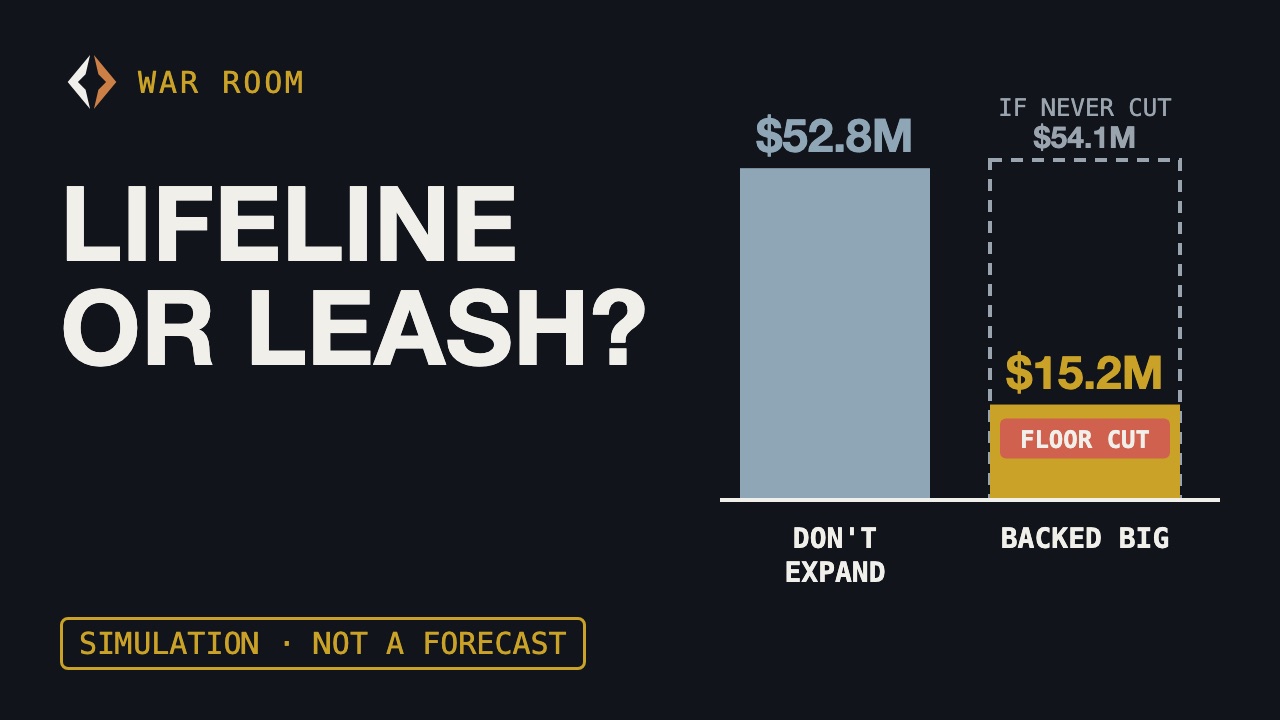
1:04Three boom quarters: cash climbs to $49.5 million. Q4: demand falls 55 percent. The supplier tops revenue up to the floor. Then, by assumption, the floor is cut in half in Q6. It ends at $15.2 million, barely under the bank loan's $15.4 million. All four after Q8: don't expand, $52.8 million; bank loan, $15.4 million.
1:36Backed big, $15.2 million; backed cautious, $14.2 million. On this War Room board, a backstop is a lifeline only while it lasts. A simulation, not a forecast. Here is the invented backstop. It is stylised, not any real contract. Each quarter, if revenue is below the floor, the supplier pays the difference. The floor is $30 million for the big build, $24 million for the cautious one.
2:11Above the floor, the supplier takes 20 percent of the extra. Backing lowers the loan rate to 8 percent. If the floor is cut, it jumps to 14 percent. The bank loan costs 10 percent, and re-prices to 14 percent when the shock hits. Price is held at $3.00 for both. Deterministic Python rules, no AI, decide every outcome.
2:39ASSUMPTION: a fictional GPU cloud with 4,000 GPUs, $26 million in cash and $150 million of debt. ASSUMPTION: a boom, then demand drops 55 percent from Q4. ASSUMPTION: each added GPU costs $30,000. The floors and rates are assumptions too. The one nobody can see in advance is whether and when the floor is cut.
3:09The central case cuts it in half in Q6, keeping 50 percent. That is only an assumption of the test, and we sweep it later. In the boom, the bigger fleets earn more, and the backed ones pay less interest. After Q3, the big build holds $49.5 million. In Q4, demand falls 55 percent. The bank loan re-prices to 14 percent and starts bleeding cash.
3:38The backed builds are topped up. The big one gets $8.4 million that quarter. In Q6, by assumption, the floor is cut in half and the rate jumps. The big build loses its lead. Watch the zero line, the shock line and the cut line. Not expanding never runs out of cash. It ends highest of the four, at $52.8 million.
4:05Now the assumption nobody controls: when is the floor cut, and how deep? Every quarter from Q4 to Q8, keeping none to all of it. That is 25 cases per backed build. For the big build, only the column where the floor is never cut ends above not expanding, by $1.3 million. A narrow margin.
4:29Cut early and deep, and it runs out of cash in 5 of 25 cases. The central case, Q6 at 50 percent, ends at $15.2 million. The cautious build runs out in 4 cases, and never beats not expanding at all. This is a range of assumptions, nothing more. What is robust: not expanding never runs out of cash in this model.
4:58The bank loan ends far below it once credit tightens. What flips: whether the backed big build is the best choice depends entirely on the floor never being cut. Cut early and deep, it is the worst of the four. What we still need is data: the real terms of any backstop, whether and how commitments are ever reduced, and how deep a real downturn runs.
5:27The simulation is over. Back to reality, and to NVIDIA's own documents. NVIDIA says it has not made any payments related to its guarantees to date. It says its maximum gross exposure from guarantees was $108.5 billion in Q2 and $118 billion in Q3. It also describes focusing on exceptional sites where durable demand can support multiple generations.
5:59The simulation cannot say three things: NVIDIA's actual terms, whether any commitment changes, or how any real company would fare. This board leaves out renegotiating the backstop, raising new money and cutting costs. It also leaves out price moves, taxes, depreciation and anything after a funding shortfall. It cannot tell you any real contract's terms, what any real company decides, or what any outcome means in real life.
6:33Treat every result as a test of rules, nothing more. So, lifeline or leash? In this model, a backstop is a lifeline only while it lasts. The clause that matters is the one that says it can be reduced. Known: what the real documents state, and the rules of this board. Assumed: every input. Simulated: every outcome.
7:02Next question: what if the supplier also owns part of you?
Corrections
None. If a fact in this film changes, the correction will be dated and shown here.
Season 2 · Follow the Money
More from this season
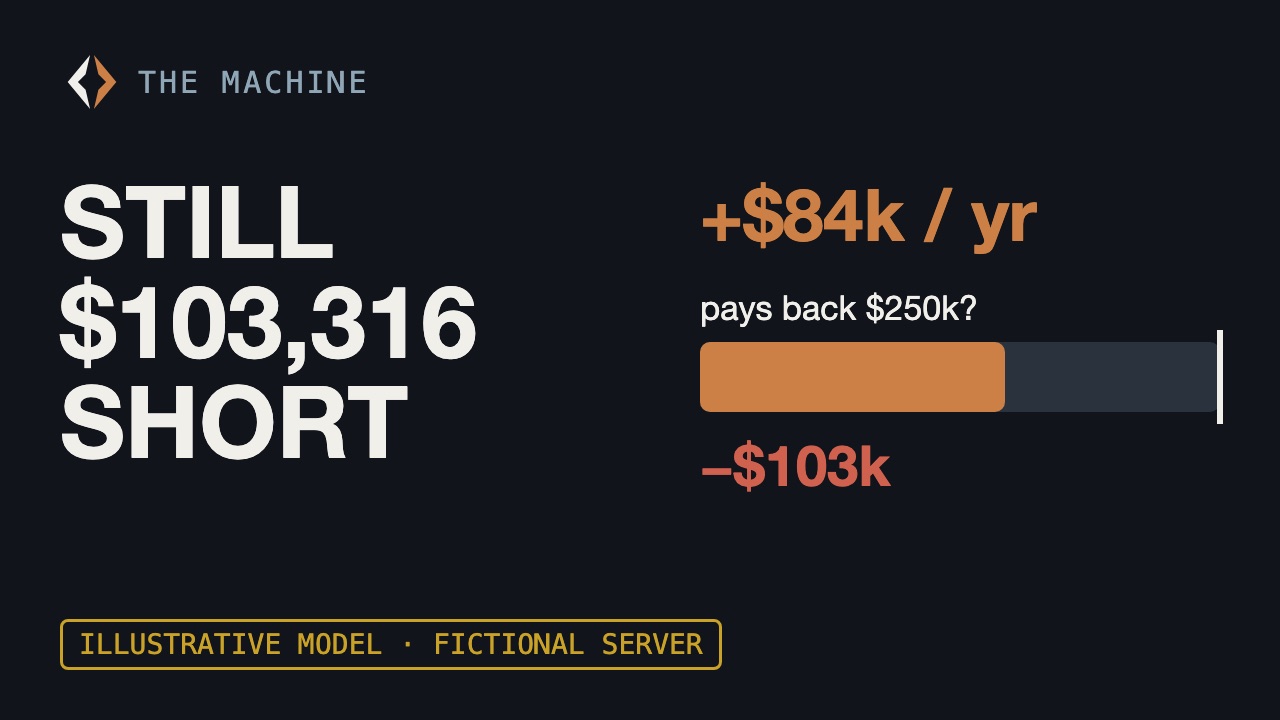
Does One Fictional AI Server Ever Pay Back?
Anyone who sees a large yearly cash figure next to a big purchase price can make the same mistake. The yearly flow and the recovery of the purchase are two different questions.
Can a Fictional AI Data Center Survive a Shock?
Any business that cuts prices to win back customers is betting on how strongly customers respond. That response is the one input nobody can observe in advance.
What Happens When a Rival Can Answer Your Price Cut?
Any price cut is a move against someone who can respond. The cut can look like a clear win until the other side answers, and you only learn how they respond after you have committed.