
What Happens When a Rival Can Answer Your Price Cut?
If a rival can see your price cut and answer it, is cutting still the right move?
Coming soon on YouTube.
In short
Any price cut is a move against someone who can respond. The cut can look like a clear win until the other side answers, and you only learn how they respond after you have committed.
This is a TWO-PLAYER PRICE-WAR SIMULATION of FICTIONAL operators. Every input and every rival behaviour is an explicit, declared assumption, and every result is a simulated outcome of a transparent, deterministic model — not a forecast, not a probability, not a statement about how any real company competes.
Assumptions and method
Formula registry
- FR_MARKET market_hours = base_market_demand × shock_t × (average_price / ref_price)^(−market_elasticity) (GPU-hours per quarter)
- FR_SHARE target_share_you = p_you^(−σ) / (p_you^(−σ) + p_rival^(−σ)); share_you = share_prev + switch_speed × (target − share_prev) (fraction)
- FR_SOLD sold_i = min(market_hours × share_i, gpu_count_i × hours_per_quarter) (GPU-hours)
- FR_REVENUE revenue_i = sold_i × price_i (USD per quarter)
- FR_CASH cash_delta_i = revenue_i − fixed_i − variable_full_i × utilization_i − debt_i × rate_i / 4 − principal_i (USD per quarter)
- FR_TIMING both prices for quarter t are chosen from quarter t−1 information; a reaction lands one quarter after the move it answers (—)
- FR_STOP the board stops for BOTH players after the first quarter in which either closing cash < 0 (modeled funding shortfall); what happens next is outside the model (—)
Assumptions (all ASSUMPTION, none calibrated to real data)
- A_FLEET
operators— Two fictional mid-size GPU clouds, identical on purpose (a mirror-image rival) so only behaviour differs. - A_LIQUIDITY
operators.you.opening_cash_usd— Same as the pilot episode: holding ends near the funding edge within six quarters. - A_FINANCING
operators.you.opening_debt_usd— Debt-financed fleets; interest and scheduled principal make fixed obligations explicit. - A_PRICE
market.baseline_price_usd_per_gpu_hour— Illustrative rental price; both start at $3.00. - A_REFPRICE
market.reference_price_usd_per_gpu_hour— Demand curve anchor. - A_DEMAND
market.baseline_market_demand_gpu_hours— Pre-shock demand fills 80% of both fleets. - A_SHOCK
market.post_shock_demand_multiplier— Hypothetical event: market demand falls 40% from quarter 2 (same as the pilot). - A_SHOCKTIME
market.shock_period— One normal quarter establishes the baseline. - A_MARKET_E
market.market_elasticity— Unknown in reality. Chosen so that, against a rival that never reacts, a cut sees the same customer response as the pilot's central case. - A_SWITCH
market.switching_sensitivity— Unknown in reality; swept 1.5–4.0. NOT an estimate. - A_SPEED
market.switch_speed— Simplification: customers move within the quarter; contracts that slow switching are left out. - A_SHARE0
market.opening_share_you— Equal start: same price, same fleet, half the market each. - A_BOUNDS
market.price_bounds— Either operator may price between $1.50 and $4.00 per GPU-hour. - A_STEP
rules.max_price_change_per_period_usd— Contracts limit repricing to $0.75 per quarter. - A_TIMING
rules— Both set prices at the same time from last quarter's information, so any answer lands one quarter after the move.
Exclusions
taxes, receivables / payment delays, depreciation, working capital, refinancing, new capacity, cost cutting, collusion or signalling, non-price competition, contract stickiness (switch_speed = 1), what happens after a funding shortfall, learning: rules never change during the game
Stylized two-player liquidity model: no taxes, receivables, depreciation, working capital, refinancing, new capacity, cost cutting, collusion, signalling or non-price competition. The board stops for both at the first modeled funding shortfall; what happens next is outside the model.
Transcript
Read the full narration (959 words)
0:00Last episode, one fictional operator faced this alone. Now, a mirror-image rival. A 40 percent drop hits both, in this hypothetical market. In this simulation, the shock quarter costs each about $5.1 million.
0:19You can hold at $3.00. Or cut 20 percent, to $2.40. The rival can answer. Its rule is unknown. Choose, before you see its move.
0:35First, a rival that never reacts. Customers move to you. In Q5, the rival runs out of cash. You keep about $8.3 million. Holding ends near $2.5 million. Same cut. Now the rival copies your price one quarter later. Customers come back. Both run out of cash in Q6. The win needed a rival standing still.
1:02Two choices, four rival rules. A cut is a bet on the rival's rule. If it cuts on its own, holding sinks you. War Room: a simulation, not a forecast. Both operators sell into one market. When the average price falls, the whole market grows a little. How much it grows is the market elasticity: 0.5 here. That is an assumption.
1:30Customers also move toward the cheaper operator. Switching sensitivity is how readily customers leave for a lower price. Here it is 3.0. Each operator then follows the same cash rules as last episode. Both set prices at the same time, from last quarter's information. So any answer lands one quarter later. The board stops when either operator runs out of cash.
2:01Deterministic Python rules decide everything. No AI decides any outcome. Assumption: two identical operators, each with 4,000 GPUs. Assumption: each starts with $26 million in cash and $150 million of debt, at 9 percent interest. Assumption: a 40 percent demand drop from Q2. Assumption: a whole-market elasticity of 0.5. And a switching sensitivity of 3.0. That is not an estimate.
2:38We sweep it from 1.5 to 4.0 later. The board tests four rival rules. Each is declared in advance and fixed for the whole game. None is a claim about any real company. Passive never changes its price. Matcher copies your last price. Undercutter, once you cut, prices 20 cents below you. Cuts on its own uses the same rule as yours.
3:06It cuts to $2.40 when its utilization, the share of its chips that are rented, falls below 70 percent. Under every rule, a price can only move a capped step each quarter. Here is one game, replayed. You cut, and the rival undercuts. Q1 is normal. Then the shock arrives in Q2. In Q3, you cut to $2.40 and win 66 percent of the market.
3:36In Q4, the rival answers. It wants to sit 20 cents below you, but the step limit holds it at $2.25. In Q5, it reaches $2.20, and your share falls to 44 percent. By Q6, both run out of cash: you at minus $4.7 million, the rival at minus $4.9 million. The cut bought you share for a while. The answer took it back.
4:05The rival never needed to be smarter. It only followed one declared rule. Now the full board, with every cell filled. On the hold row, three rivals only react. Against them nothing happens, and both end near $2.5 million. Two cells end in Q5. Hold against a rival that cuts on its own: you run out of cash, at minus $1.0 million.
4:34Cut against a passive rival: it runs out of cash, and you keep $8.3 million. Every other cut is answered, and both run out of cash in Q6. Against a matcher, you end at minus $2.2 million and the rival at minus $5.3 million. Against an undercutter, minus $4.7 million and minus $4.9 million. Against a rival that cuts on its own, minus $4.2 million each.
5:04Now the stress test. Switching sensitivity is the one market assumption nobody can observe, so we sweep it from 1.5 to 4.0. It is a range of assumptions, nothing more. Against a matcher, your cut runs out of cash at every level tested. Against a passive rival, the rival runs out first from 2.0 upward.
5:29At 1.5, both run out. But a cut is not always better than holding. At 2.0 you end with $0.6 million, at 2.5 with $2.2 million. Holding ends at $2.5 million. Only from 3.0 does the cut leave you ahead of holding: $8.3 million at 3.0, up to $10.5 million at 4.0. And if the rival cuts on its own while you hold, you run out of cash at every level.
6:02Robust: an answered cut sinks both operators at every switching level we tested. Also robust: holding against a rival that cuts on its own runs out of cash at every level. What flips is the payoff of your cut. It depends entirely on the rival's rule. The same cut can leave you ahead, or run you out of cash.
6:25Data needed: how real rivals react, and how fast; how readily real customers switch; and contract terms. This model cannot measure any of them. This board leaves out a lot. No learning: the rules never change mid-game. No collusion, no signalling. No contracts that slow switching. No service differences. Nothing after a funding shortfall. It cannot say what any real company would do, and it makes no claim about how often any outcome occurs.
7:03So, what happens when a rival can answer your price cut? In this model, a cut is a bet on the rival's rule. And you only see that rule after its first answer. That is one quarter too late. Known: the rules of the board. Assumed: every input and every behaviour. Simulated: every outcome. The open question: how real rivals actually react, and how fast.
7:31This board cannot say. The next question: what changes if the rival can see that your cash is running low?
Corrections
None. If a fact in this film changes, the correction will be dated and shown here.
Season 2 · Follow the Money
Up next
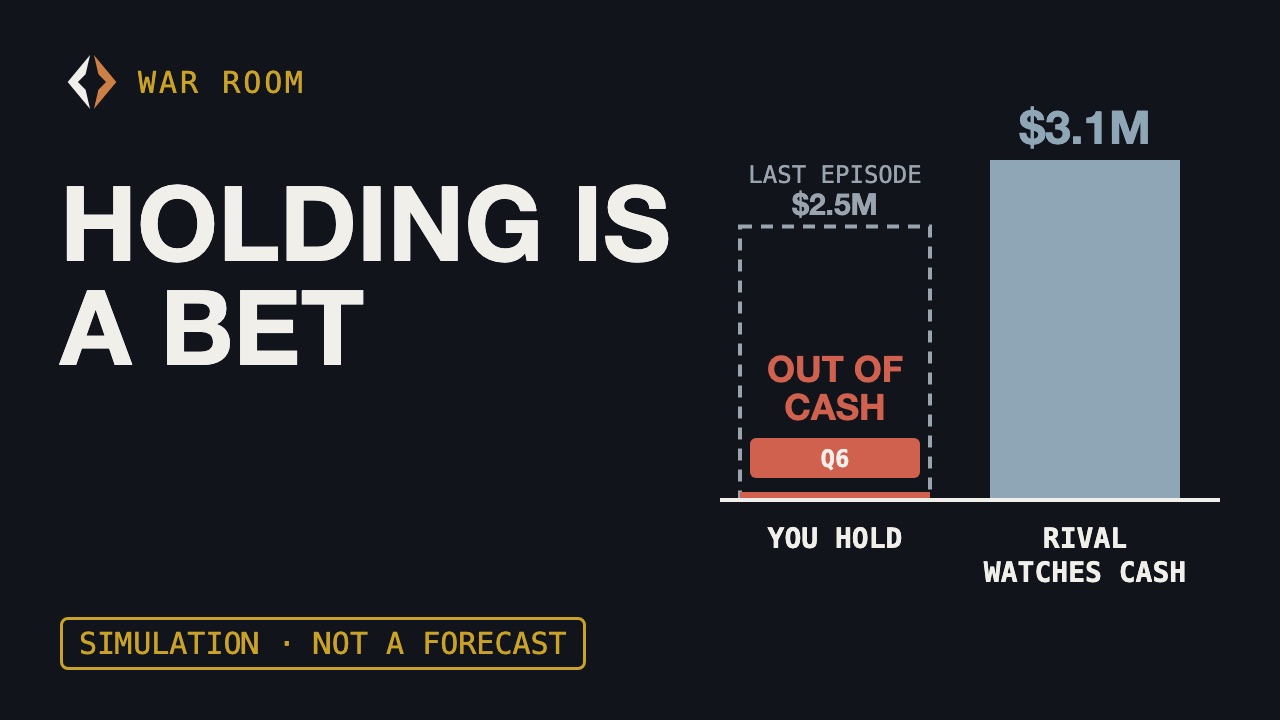
What Happens When a Rival Can See Your Cash?
A habit that looked safe can stop being safe once someone else can see your weak point. This model shows that change on a small board, with rules anyone can check.
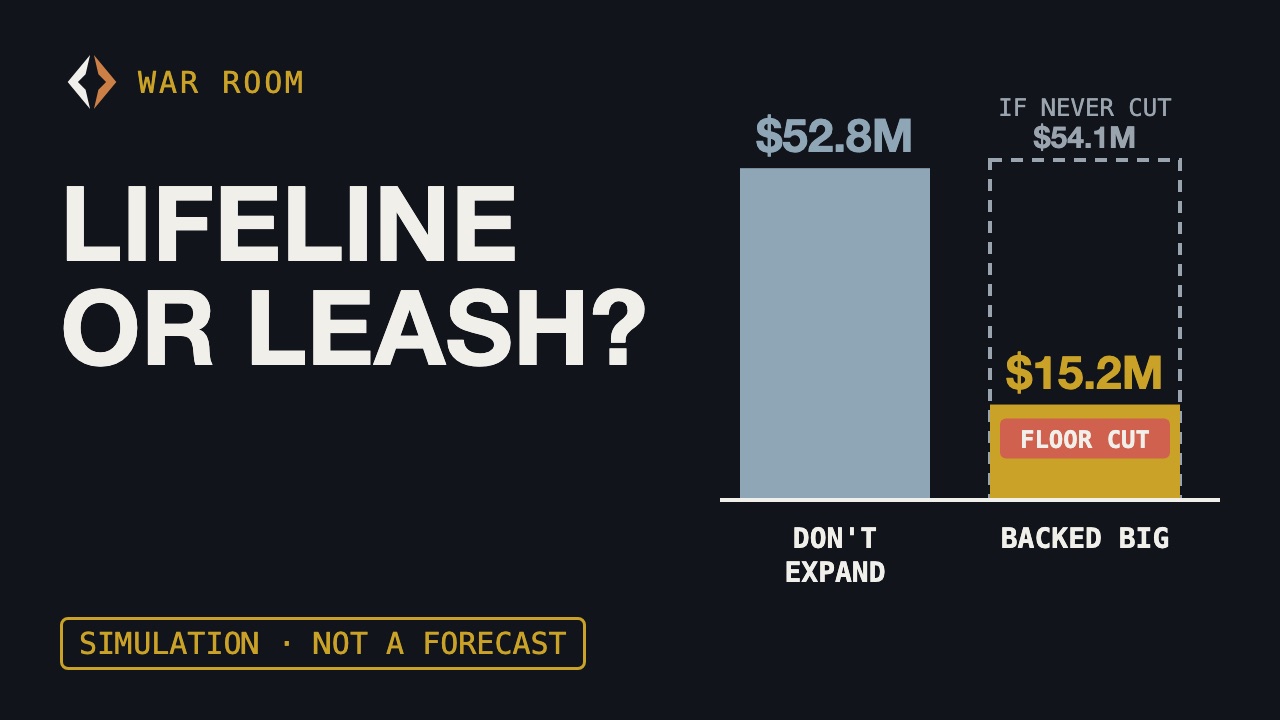
Lifeline or Leash? A War Room Simulation of Chip Backstops
GPU cloud companies borrow heavily to buy chips. If the lender and the supplier are tied together, the terms of that support decide who is exposed when demand drops.
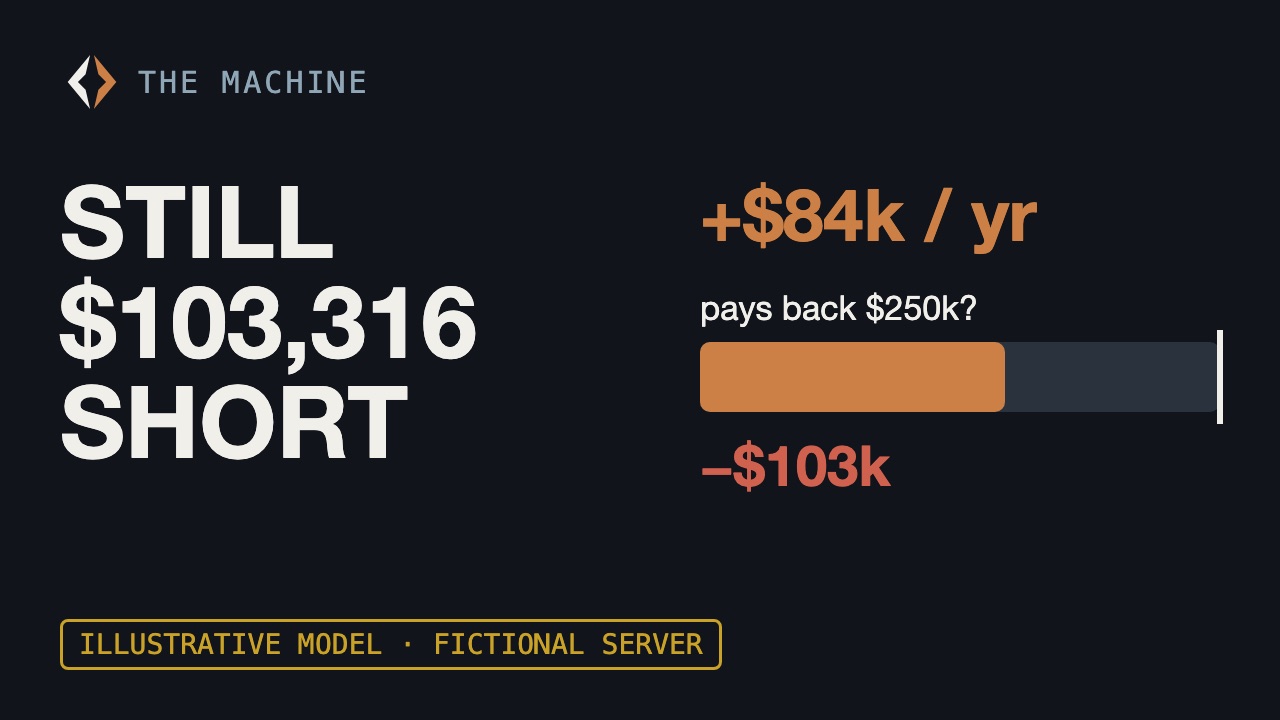
Does One Fictional AI Server Ever Pay Back?
Anyone who sees a large yearly cash figure next to a big purchase price can make the same mistake. The yearly flow and the recovery of the purchase are two different questions.