
The Six Gates Behind Every AI Answer
Who controls the computing power behind AI, and what happens when a critical dependency fails?
Coming soon on YouTube.
In short
The intelligence may be digital, but the business is physical: chips, memory, racks, power, money and rules each have their own owners and limits.
COMPUTEWARS FOUNDATIONS: a beginner's map of the six gates behind every AI answer. Real figures are quoted or restated from the sources below; counters, meters and machine scenes are illustrations, not data or footage. The IEA figure for 2030 is a projection for all data centres, not only AI.
On the record · 8 claims
-
The IEA projects data-centre electricity consumption roughly doubling from 485 TWh in 2025 to 950 TWh in 2030.
“Our updated projections see electricity consumption from data centres roughly doubling from 485 TWh in 2025 to 950 TWh in 2030”
International Energy Agency · Key Questions on Energy and AI: Executive summary (2026)
-
NVIDIA introduced CUDA in 2006 to let computational workloads use GPUs independent of graphics APIs.
“In 2006, NVIDIA introduced the Compute Unified Device Architecture (CUDA) to enable any computational workload to use the throughput capability of GPUs independent of graphics APIs”
NVIDIA Corporation · CUDA Programming Guide: Introduction (accessed 2026-11-26)
-
ASML says its EUV lithography prints microchips using light with a wavelength of 13.5 nm.
“prints microchips using light with a wavelength of just 13.5 nm”
ASML · EUV lithography systems (accessed 2026-11-22)
-
ASML says microchips are made by building up layers of patterns on a silicon wafer, in hundreds of steps.
“Microchips are made by building up layers of interconnected patterns on a silicon wafer. The microchip manufacturing process involves hundreds of steps”
ASML · How microchips are made (accessed 2026-11-26)
-
TSMC's annual report describes its advanced packaging and 3D chip stacking technologies, including CoWoS.
“We are also developing advanced packaging and 3D chip stacking technologies, including CoWoS”
TSMC · 2025 Annual Report (letter to shareholders) (2025 annual report)
-
SK hynix reported that sales of HBM4 expanded and expects HBM4 to be the mainstream product from the fourth quarter.
“Sales of HBM4 and high-value-added server products expanded; HBM4 expected to be the mainstream product from the fourth quarter”
SK hynix · SK hynix Q3 2026 business results (2026-10-28)
-
BIS says the rule is meant to stop existing restrictions being circumvented through remote computing arrangements in third countries.
“The rule is designed to ensure that existing restrictions on access to sensitive American technology cannot be circumvented through remote computing arrangements involving data centers in third countries”
U.S. Bureau of Industry and Security · BIS Issues Rule Addressing Remote Access to American Super Intelligence Technology (2026-11-16)
-
The IEA's Key Questions on Energy and AI is cited as a 2026 IEA report.
“IEA (2026), Key Questions on Energy and AI, IEA, Paris”
International Energy Agency · Key Questions on Energy and AI: Executive summary (2026)
Sources
- International Energy Agency Key Questions on Energy and AI: Executive summary (2026)
- NVIDIA Corporation CUDA Programming Guide: Introduction (accessed 2026-11-26)
- ASML EUV lithography systems (accessed 2026-11-22)
- ASML How microchips are made (accessed 2026-11-26)
- TSMC 2025 Annual Report (letter to shareholders) (2025 annual report)
- SK hynix SK hynix Q3 2026 business results (2026-10-28)
- U.S. Bureau of Industry and Security BIS Issues Rule Addressing Remote Access to American Super Intelligence Technology (2026-11-16)
Transcript
Read the full narration (969 words)
0:00Imagine you have just bought the computers for a new AI data center. The racks are installed. The model is ready. Customers are waiting. But the computers cannot do the one thing they were built to do: run. The local grid cannot deliver the power your building needs. On paper, you own extraordinary computing capacity.
0:24In reality, you own expensive equipment waiting for permission to become useful.
0:31That is the strange truth about artificial intelligence. The intelligence may be digital. The business is physical.
0:43Let’s follow a single request. You type a question. The service converts text into units the model can process, then runs layer after layer of calculations to produce an answer. That is inference. Training is different: it is the much larger process of adjusting a model using examples and optimization. Both use computing power, but they consume that power in different patterns.
1:13A GPU can do many suitable operations in parallel. That makes accelerators useful for a large class of AI workloads. But a specification like peak floating-point operations per second is not the same as the speed, cost or quality of an actual answer. The software, memory, model design and workload all matter. The first gate is not ‘buy the biggest chip.’ It is ‘match the work to a machine that can actually perform it.’ A chip is not a magic box.
1:50Developers need tools to make it useful. In 2006, NVIDIA introduced CUDA, allowing programmers to use its GPUs for general-purpose parallel computing. Over time, software libraries, researchers, infrastructure teams and trained engineers accumulated around that approach. This creates a real business advantage: changing the hardware may mean changing code, retraining teams, validating results and accepting operational risk.
2:26That is an inference about switching costs, not proof that every customer is trapped. It also explains why a competitor cannot win simply by putting a bigger number on a specification sheet. They must help customers move real workloads at a better total outcome. The second gate is software compatibility. Now the machine has to exist.
2:51Designing an accelerator and manufacturing it are different businesses. A chip designer needs fabrication capacity. Modern chipmaking builds up layers of patterns on a silicon wafer, in hundreds of steps. For parts of the most advanced production, extreme-ultraviolet lithography matters. ASML describes the light in these systems as having a wavelength of 13.5 nanometers. The number describes the light—not the literal width of every transistor.
3:28The job does not end when the logic die is fabricated. High-bandwidth memory moves data close to the processor. Advanced packaging connects complex components inside a functioning product. TSMC's annual report describes its foundry business and its advanced packaging technologies, including CoWoS. Memory producers such as SK hynix supply another indispensable technology family. A single finished accelerator can therefore depend on multiple industrial specialists, each operating under its own capacity, capital and yield constraints.
4:12The third gate is not a single company. It is a coordinated manufacturing system. A pile of working chips is still not an AI service. They must exchange data quickly enough to work together. They need memory, interconnects, switches, storage, cooling and technicians who can keep everything operating. Move information too slowly between processors and a powerful machine waits instead of calculating.
4:44Fail to remove the heat and it slows down or shuts down. A rack is a whole system, not a shopping cart of individual GPUs. That is why any price for ‘an AI rack’ needs the exact configuration, purchase date, networking and service scope. There is no universal rack price that tells the economic story.
5:08The fourth gate is making components behave like one reliable machine. Then comes the input that no software update can create: dependable electricity. The grid must provide enough power, at the right location, over the hours the computers need it. Building faster chips does not build a substation faster. The International Energy Agency’s 2026 central outlook estimates that all data centers used about 485 terawatt-hours in 2025 and could use roughly 950 by 2030.
5:50That second figure is a projection, and it includes more than AI workloads. Grid connections, transformers, turbines, transmission lines and local approvals have their own lead times. Some operators consider on-site generation or storage, but neither makes engineering, cost and permitting constraints disappear. A facility may own the right hardware in the wrong place, or at the wrong time.
6:21This is the fifth gate—and it can overrule the first four. The sixth gate determines whether all that capacity becomes a sustainable business. Someone must pay for chips, equipment, buildings and financing—often before customer demand is certain. The operator then needs enough paid utilization to cover electricity, cooling, networking, labor, repairs and eventually its investment.
6:51Bigger capital spending is not the same as bigger AI revenue. Market forecasts are not signed contracts. And lower cost per calculation does not guarantee higher profit if customers pay less or workloads move to more efficient models. Policy also matters. Governments can restrict particular chip exports or forms of access. Those rules change, and their impact depends on the product, customer and location.
7:23Money and rules decide who can actually operate the machines at scale. So who controls AI compute? Not one chip company, one data center, or one country. Different actors control different bottlenecks. A designer may lead in software, a fabricator in manufacturing, a memory supplier in bandwidth, a utility in delivered power, a financier in what gets built and a government in what can cross a border.
7:56And all of them still depend on customers finding value. The most important question is no longer just ‘How powerful is the chip?’ It is: ‘Who can turn it into reliable, paid computing power—and who has the ability to stop them?’ That is the system behind every answer. And it is where ComputeWars begins.
Corrections
None. If a fact in this film changes, the correction will be dated and shown here.
Season 1 · Foundations
Up next

Who Really Controls the AI Chip Supply Chain?
Headlines ask who 'controls AI chips'; the public records show a map of who could delay whom, and what stays unknown.
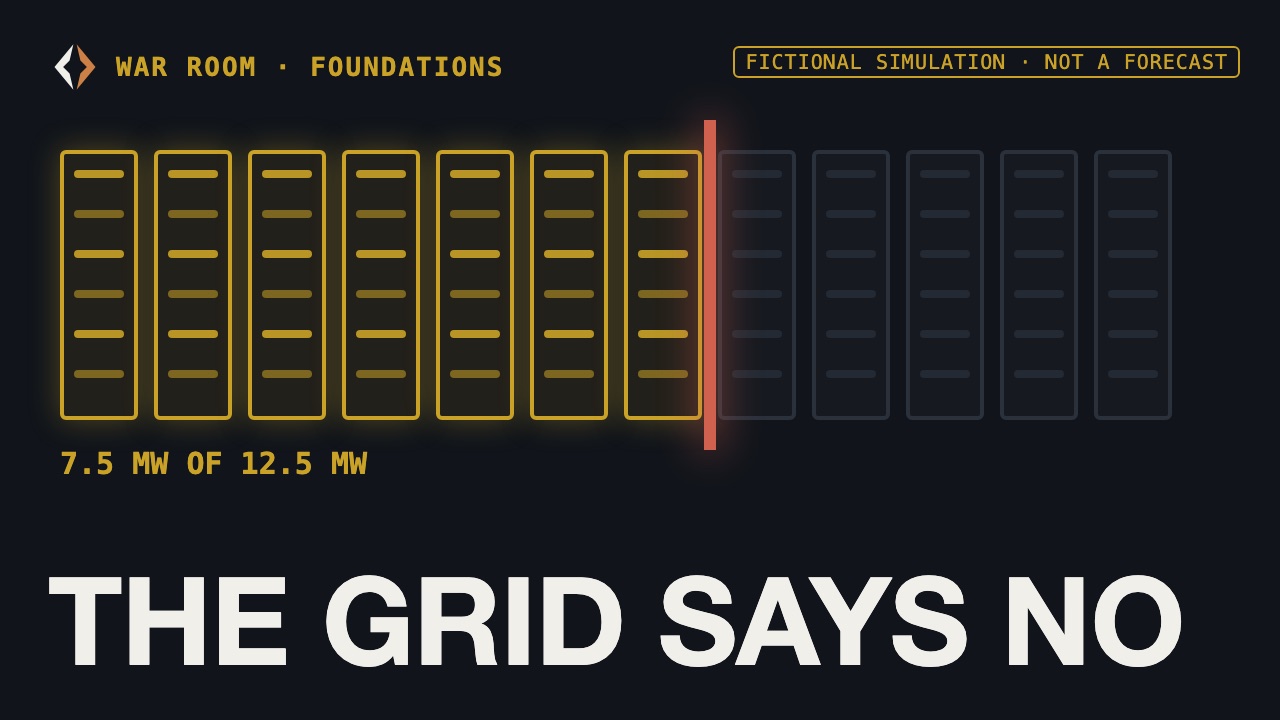
Your AI Data Center Is Built. The Grid Says No.
Power delays turn chips into idle capital; the value of a year depends on demand, competition and alternatives.

The AI War Isn't Just About Chips
The chip is only one part of a much larger machine; any link can stop the service.