
Who Really Controls the AI Chip Supply Chain?
What can verified company records establish about control, dependency and bargaining power in the AI chip supply chain?

Coming soon on YouTube.
In short
Headlines ask who 'controls AI chips'; the public records show a map of who could delay whom, and what stays unknown.
COMPUTEWARS FOUNDATIONS · CASE FILES. Every fact on screen is quoted from or restated from the sources below; company claims, forecasts and inferences are labelled as such. Quoted text is typeset, not a screenshot. No wrongdoing is alleged.
On the record · 18 claims
-
NVIDIA introduced CUDA in 2006 to let computational workloads use GPUs independent of graphics APIs.
“In 2006, NVIDIA introduced the Compute Unified Device Architecture (CUDA) to enable any computational workload to use the throughput capability of GPUs independent of graphics APIs”
NVIDIA Corporation · CUDA Programming Guide: Introduction (accessed 2026-11-26)
-
TSMC's 2025 annual report opens: 2025 was another strong year for TSMC.
“2025 was another strong year for TSMC.”
TSMC · 2025 Annual Report (letter to shareholders) (2025 annual report)
-
TSMC describes its business as a pure-play foundry.
“Our success is predicated on our steadfast adherence to the pure-play foundry business model”
TSMC · 2025 Annual Report (letter to shareholders) (2025 annual report)
-
TSMC's annual report describes its advanced packaging and 3D chip stacking technologies, including CoWoS.
“We are also developing advanced packaging and 3D chip stacking technologies, including CoWoS”
TSMC · 2025 Annual Report (letter to shareholders) (2025 annual report)
-
ASML says its EUV lithography prints microchips using light with a wavelength of 13.5 nm.
“prints microchips using light with a wavelength of just 13.5 nm”
ASML · EUV lithography systems (accessed 2026-11-22)
-
ASML says microchips are made by building up layers of patterns on a silicon wafer, in hundreds of steps.
“Microchips are made by building up layers of interconnected patterns on a silicon wafer. The microchip manufacturing process involves hundreds of steps”
ASML · How microchips are made (accessed 2026-11-26)
-
ASML says its EUV machines are used for the most critical layers with the smallest features.
“Our latest-generation EUV (extreme ultraviolet) machines are used for the most critical layers with the smallest features”
ASML · How microchips are made (accessed 2026-11-26)
-
SK hynix reported that sales of HBM4 expanded and expects HBM4 to be the mainstream product from the fourth quarter.
“Sales of HBM4 and high-value-added server products expanded; HBM4 expected to be the mainstream product from the fourth quarter”
SK hynix · SK hynix Q3 2026 business results (2026-10-28)
-
AMD launched its Instinct MI400 Series GPUs at Advancing AI 2026.
“At Advancing AI 2026, AMD launches 6th Gen AMD EPYC™ CPUs, AMD Instinct™ MI400 Series GPUs”
AMD · AMD Advancing AI 2026 press release (2026)
-
AMD's rack-scale solutions are accelerated by its ROCm open software.
“accelerated by AMD ROCm™ open software”
AMD · AMD Advancing AI 2026 press release (2026)
-
Google Cloud describes TPU7x as the first release in the Ironwood family, its seventh-generation TPU, designed for large-scale AI training and inference.
“TPU7x is the first release within the Ironwood family, Google Cloud's seventh generation TPU. The Ironwood generation is designed for large-scale AI training and inference”
Google Cloud · TPU7x (Ironwood) documentation (accessed 2026-11-26)
-
AWS made EC2 Trn3 UltraServers, powered by its Trainium3 chip, generally available.
“AWS announces the general availability of Amazon Elastic Compute Cloud (Amazon EC2) Trn3 UltraServers powered by our fourth-generation AI chip Trainium3”
Amazon Web Services · Amazon EC2 Trn3 UltraServers generally available (2025-12-02)
-
AWS says Trn3 UltraServers are powered by the AWS Neuron SDK.
“New Trn3 UltraServers are built for AI researchers and powered by the AWS Neuron SDK”
Amazon Web Services · Amazon EC2 Trn3 UltraServers generally available (2025-12-02)
-
NVIDIA published its third-quarter results on November 17, 2026, for the quarter ended October 25, 2026.
“Nov. 17, 2026 (GLOBE NEWSWIRE) -- NVIDIA (NASDAQ: NVDA) today reported revenue for the third quarter ended October 25, 2026”
NVIDIA Corporation · NVIDIA Announces Financial Results for Third Quarter Fiscal 2027 (2026-11-17)
-
NVIDIA reported revenue of $115.8 billion for the third quarter ended October 25, 2026.
“today reported revenue for the third quarter ended October 25, 2026, of $115.8 billion”
NVIDIA Corporation · NVIDIA Announces Financial Results for Third Quarter Fiscal 2027 (2026-11-17)
-
NVIDIA reported Data Center third-quarter revenue of $107.6 billion.
“Third-quarter revenue was $107.6 billion”
NVIDIA Corporation · NVIDIA Announces Financial Results for Third Quarter Fiscal 2027 (2026-11-17)
-
On November 16, 2026, BIS released an interim final rule to address remote access to advanced super intelligence chips and servers.
“FOR IMMEDIATE RELEASE | November 16, 2026 | Media Contact: [email protected] BIS Issues Rule Addressing Remote Access to American Super Intelligence Technology Download as PDF WASHINGTON, D.C. - Today, the U.S. Commerce Department's Bureau of Industry and Security (BIS) released an interim final rule (IFR)-written by and at the direction of the Department of Treasury and the National Security Council-to address remote access to advanced super intelligence (SI) chips and servers”
U.S. Bureau of Industry and Security · BIS Issues Rule Addressing Remote Access to American Super Intelligence Technology (2026-11-16)
-
BIS says the rule is meant to stop existing restrictions being circumvented through remote computing arrangements in third countries.
“The rule is designed to ensure that existing restrictions on access to sensitive American technology cannot be circumvented through remote computing arrangements involving data centers in third countries”
U.S. Bureau of Industry and Security · BIS Issues Rule Addressing Remote Access to American Super Intelligence Technology (2026-11-16)
Sources
- NVIDIA Corporation NVIDIA Announces Financial Results for Third Quarter Fiscal 2027 (2026-11-17)
- NVIDIA Corporation CUDA Programming Guide: Introduction (accessed 2026-11-26)
- ASML EUV lithography systems (accessed 2026-11-22)
- ASML How microchips are made (accessed 2026-11-26)
- TSMC 2025 Annual Report (letter to shareholders) (2025 annual report)
- SK hynix SK hynix Q3 2026 business results (2026-10-28)
- AMD AMD Advancing AI 2026 press release (2026)
- Google Cloud TPU7x (Ironwood) documentation (accessed 2026-11-26)
- Amazon Web Services Amazon EC2 Trn3 UltraServers generally available (2025-12-02)
- U.S. Bureau of Industry and Security BIS Issues Rule Addressing Remote Access to American Super Intelligence Technology (2026-11-16)
Transcript
Read the full narration (1037 words)
0:00You can admire an AI accelerator and think one company made it. The reality is stranger. A leading chip company can design the processor and build the software platform—and still depend on other businesses to turn that design into a usable product. A factory may manufacture advanced silicon and still depend on specialized equipment. A working processor may be useless without enough suitable memory, packaging capacity or power.
0:35So when a headline asks who ‘controls AI chips,’ what exactly is being controlled? We opened the public records, not to crown one winner, but to draw a map of who could delay whom.
0:50Start before the current AI boom. NVIDIA’s own programming documentation dates CUDA to 2006. The strategic significance is not only that programmers could run suitable general-purpose workloads on GPUs. It is what happens over many years when the tools, libraries, debugging knowledge and deployment processes become familiar. A machine can be technically capable and commercially unattractive if adopting it forces an organization to rebuild half its workflow.
1:26This is why platform competition is not decided by a transistor count. Yet we should avoid the opposite exaggeration. CUDA is influential; it is not proof that rival platforms cannot run serious AI. Software compatibility creates a cost to change, but the size of that cost varies enormously by workload and organization. The evidence supports a durable ecosystem.
1:55It does not support a universal captive-customer narrative. Next, a distinction too often lost in talk about chip giants: design is not the same as fabrication. TSMC’s 2025 annual report describes its foundry business, advanced processes and packaging technologies. The fab is not a printer that receives a finished chip and presses ‘start.’ It is a vast manufacturing process involving patterning, materials, metrology, yield and production planning.
2:32Each extra production stage creates constraints. Capacity is planned years ahead. Yield affects how much sellable hardware emerges. And a vendor can have demand for chips without instantly owning the capacity to deliver them. What can we prove from public filings? That foundry capability and packaging technology are crucial businesses in their own right. What we cannot prove from a broad annual report is the secret allocation of capacity to every customer, or the leverage contained in each private contract.
3:12Keep that unanswered. A modern fab also relies on extraordinary machines. ASML’s official materials explain extreme-ultraviolet lithography, using light with a 13.5-nanometer wavelength to pattern very fine features in advanced manufacturing. Those systems are engineering achievements in their own right. But we must be precise about what that says. A wavelength is not a complete description of chip geometry.
3:46Lithography is one stage in a much longer production flow. It is nevertheless a useful demonstration of industrial dependency: a company delivering advanced chips can be exposed to the capacity, reliability and development pace of another company’s equipment. ‘Strategic importance’ is supported. A claim that a toolmaker can simply switch off every rival at will is not.
4:16Even with a functioning logic die, data has to reach the compute cores quickly enough to keep them useful. That’s why high-bandwidth memory has become central to advanced AI systems. SK hynix publishes its own HBM production developments, while TSMC documents advanced packaging, including CoWoS. These are separate products and processes that must meet inside the final system.
4:48More arithmetic capability is not always the constraint if memory movement or package integration cannot keep up. This creates interdependence, not a simple chain of command. The source documents tell us these technologies and businesses are material. They do not reveal every customer’s purchase price, supply priority or contracted margin. In our case file, those details stay explicitly unresolved.
5:18The competitive map also has alternatives. AMD has its Instinct accelerator family and software ecosystem. Google develops and operates TPUs. AWS offers Trainium and a corresponding software stack. Each model of competition is different. A merchant accelerator can be purchased or deployed by other operators. A cloud-designed accelerator may be optimized around a provider’s own service and developer tools.
5:52Both can matter to customers. But declaring a winner from vendor peak-performance claims is not a fair comparison. We would need matched models, precision, batch sizes, software maturity, pricing, networking, availability and real throughput per dollar. If we cannot get that evidence, we can compare business strategies, not fabricate a leaderboard. These dependencies have turned into an enormous business.
6:24In results published November seventeenth, twenty twenty-six, NVIDIA reported total quarterly revenue of 115.8 billion US dollars, including 107.6 billion from its Data Center business, for the quarter ended October twenty-fifth. Those are reported revenues, not a measure of the value created by every AI application, and not proof that all customers will earn adequate returns.
6:55A chip can be commercially successful while a particular data-center project struggles with financing, utilization or grid access. The companies designing, manufacturing, packaging, networking and running AI infrastructure participate in very different economics. One industry’s revenue is another company’s capital cost. To map power, follow both the technology interfaces and the money flows. There is also a form of power that does not fit on a chip diagram.
7:31Governments control some exports, licenses and access conditions. United States policies on advanced chips and remote access have changed over time, including developments in twenty twenty-six. These rules can influence who can buy, deploy or access particular systems, but their exact reach depends on the actual legal text and effective dates. We should not reduce a global industrial network to a sporting score between countries.
8:06Research, chip design, manufacturing, memory, energy, money and regulations are distributed across regions. The result is a system of concentrated specialties and mutual dependencies. The public evidence does not permit a simple single-owner verdict. Here is the verdict. Known: modern AI compute depends on software, advanced fabrication, packaging, memory, complete systems and power. Known: major companies publicly document their role in those layers.
8:46Inferred: specialization creates leverage because replacing a critical part can take time, investment and engineering work. Unresolved: the precise customer-by-customer bargaining power, supply allocation and private contract terms. The companies may fight for the economics. They still depend on one another for the machine to work. The next investigation starts at the point where these dependencies become a financial decision.
Corrections
None. If a fact in this film changes, the correction will be dated and shown here.
Season 1 · Foundations
Up next
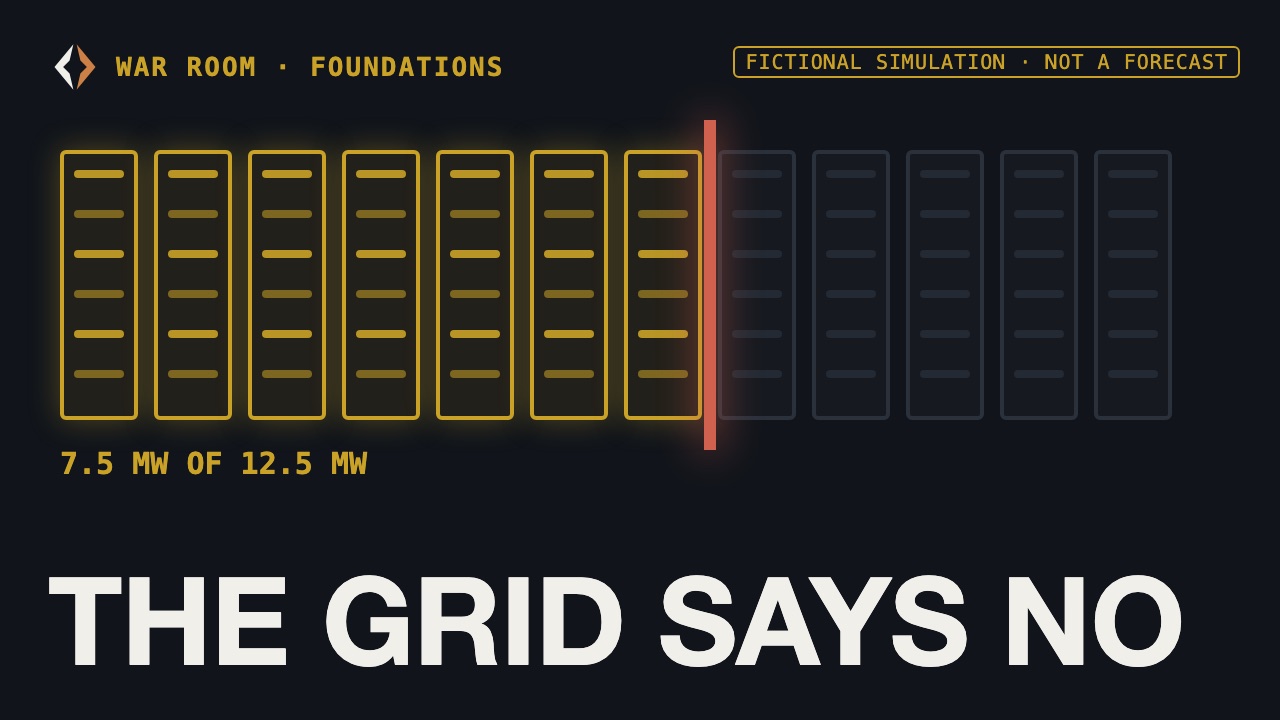
Your AI Data Center Is Built. The Grid Says No.
Power delays turn chips into idle capital; the value of a year depends on demand, competition and alternatives.

The AI War Isn't Just About Chips
The chip is only one part of a much larger machine; any link can stop the service.
The Six Gates Behind Every AI Answer
The intelligence may be digital, but the business is physical: chips, memory, racks, power, money and rules each have their own owners and limits.