
Your AI Data Center Is Built. The Grid Says No.
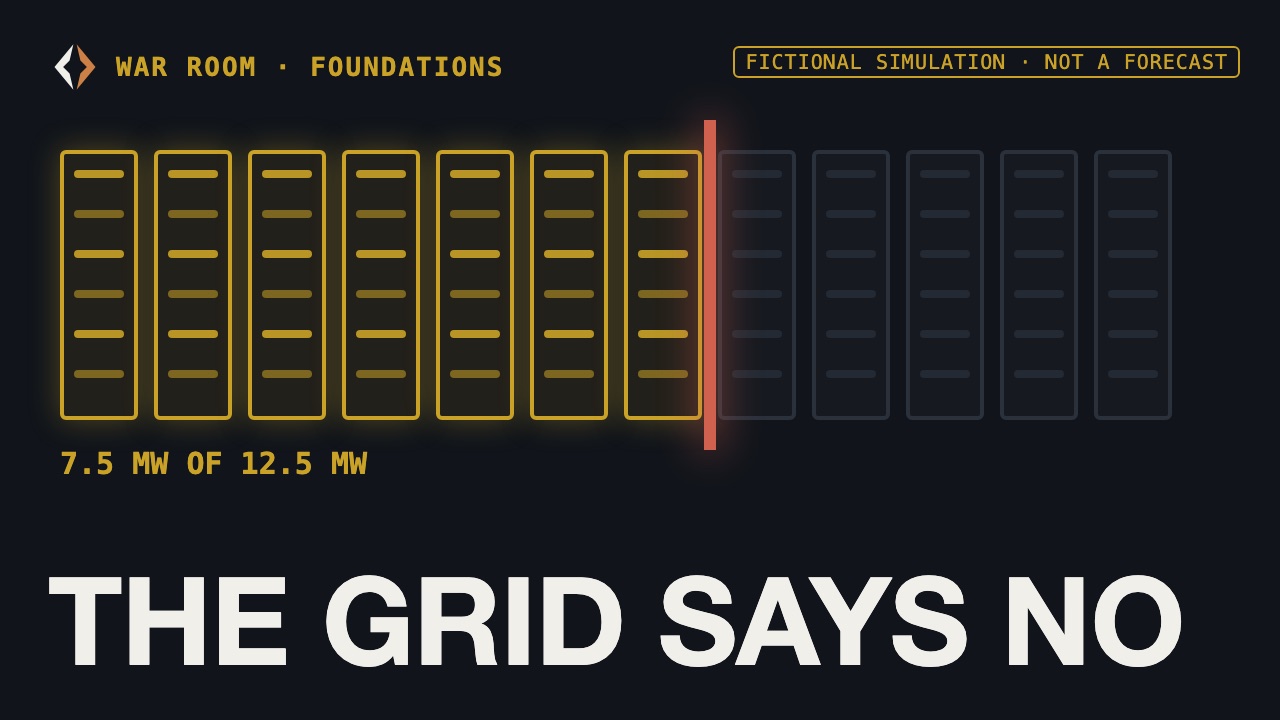
When the grid can power only part of a finished AI data center, should you build everything, phase the hardware, or pay for earlier on-site power?
Coming soon on YouTube.
In short
Power delays turn chips into idle capital; the value of a year depends on demand, competition and alternatives.
FICTIONAL STRATEGY SIMULATION. Larkfield Compute is a fictional operator. Every input is an illustrative assumption, not market data, and every result is a model output: not a forecast and not investment advice. The model is published with its assumptions so anyone can rerun it.
Assumptions and method
Model models/foundations/cw_foundations_power_v1.py (sha256 c8c4245e84818b596e9f53d17c0a33589a11685837623372fb66a01f1f5f2860), version cw_foundations_power_v1.0, owner-supplied and used unchanged. Output hash 7749606f778c694c486c9c2dd7408caa5904e4f5698e36f618ff61bbbeae0d67; replay: byte-identical (2 runs).
Scope: Five-year project NPV, USD; all numerical inputs illustrative; no market forecasts
Inputs (all ILLUSTRATIVE ASSUMPTIONS)
- gpu_target = 4000
- power_delivered_first_2_years_mw = 7.5
- power_full_from_year_3_mw = 12.5
- it_kw_per_accelerator_allocated = 2.5
- pue = 1.25
- hardware_and_install_capex_per_accelerator_usd = 60000
- staged_later_hardware_discount = 0.20
- onsite_generation_initial_capex_usd = 55000000
- onsite_generation_extra_annual_cost_usd = 3200000
- annual_contribution_per_online_unit_at_70pct_utilization_usd = 30000
- reference_utilization = 0.70
- annual_contribution_retention = 0.83
- discount_rate = 0.12
- horizon_years = 5
5-year NPV by scenario (model output, USD)
| Utilization | build_all_now | phase_hardware | onsite_generation | Winner |
|---|---|---|---|---|
| 0.45 | -81414768.41 | -46639258.21 | -99981757.80 | phase_hardware |
| 0.70 | 6688138.03 | 41463648.23 | 14770201.12 | phase_hardware |
| 0.90 | 77170463.18 | 111945973.38 | 106571768.25 | phase_hardware |
| 1.00 | 112411625.76 | 147187135.96 | 152472551.82 | onsite_generation |
| 0.90 | 211865179.67 | 246640689.88 | 249630187.37 | onsite_generation |
Note: Last row: the model's alternate case at 0.90 utilization with no year-on-year decline in contribution (retention 1.00), included to show when on-site generation wins.
Transcript
Read the full narration (860 words)
0:00You’ve raised the money. You’ve signed the purchase order. The AI customers are waiting. Your planned campus needs 12.5 megawatts, but the grid can deliver only 7.5 for the next two years.
0:16Do you buy all the hardware now and leave part idle? Buy less now, then finish the build when power arrives? Or pay extra to secure an earlier, fictional on-site generation solution? Those are three different bets on demand, timing and the value of a year. This is War Room. The company is fictional. The numbers are declared assumptions, and the rules—not a narrator’s preference—will decide the outcomes.
0:49Meet Larkfield Compute. It wants four thousand accelerators. For this exercise, each deployed accelerator accounts for 2.5 kilowatts of information-technology load, including its allocated supporting equipment. A modeled facility efficiency factor of 1.25 brings the total electricity requirement to 12.5 megawatts. With only 7.5 megawatts at first, the utility can support 2,400 units. Full connection arrives in year three.
1:26We assume hardware and installation cost sixty thousand dollars per accelerator. At seventy percent paid utilization, one online accelerator contributes thirty thousand dollars in the first year after modeled operating costs but before capital, financing and taxes. That contribution falls seventeen percent per year as competition changes pricing. We examine five years and discount future cash at twelve percent annually.
2:00These are hypothetical inputs, not claimed industry averages. Strategy one: buy all four thousand now. You spend two hundred and forty million dollars immediately. But only two thousand four hundred can generate value in years one and two. The remaining sixteen hundred become useful in year three, if the assumed grid expansion happens on schedule.
2:28That could protect you from future price rises or shortages, a benefit this model does not count. But it ties up money in idle assets. Under our base assumptions, the five-year discounted project value is about positive 6.7 million dollars. That is not accounting profit. It is a simplified discounted cash-flow result under this rulebook.
2:56Strategy two: purchase only what the grid can power. The first twenty-four hundred units cost one hundred and forty-four million dollars. At the end of year two, you buy the remaining sixteen hundred at an assumed twenty percent lower purchase price: seventy-six point eight million dollars. The last units arrive as more power becomes available.
3:21This assumes equipment delivery happens when needed, which is never guaranteed in real projects. On the same baseline, its five-year discounted project value is approximately positive 41.5 million dollars. Fewer shiny machines on day one. More value preserved in the scenario. Strategy three: pay for an earlier on-site power solution. Our fictional company spends an additional fifty-five million dollars up front and three point two million per year in incremental costs.
4:00In the scenario, permits, fuel, engineering, equipment delivery and commissioning are assumed to be solved in time for year one. In the real world, none of that can be assumed away. The reward is access to all four thousand accelerators immediately. But the extra capital and operating costs are heavy. Under the baseline, this strategy delivers approximately positive 14.8 million dollars in discounted project value.
4:33Better than buying everything and waiting. Worse than phasing. But a result is only as strong as its assumptions. Turn paid utilization down to forty-five percent. All three strategies lose modeled value. Phasing still loses the least. At seventy percent, phasing wins clearly. At ninety percent, it still leads—but only just. Now imagine the equipment is fully utilized throughout.
5:05Our model puts the earlier-power option ahead. Or keep utilization at ninety percent and assume no annual erosion in unit contribution. Again, the value of getting the full capacity online earlier becomes large enough to change the winning choice. This is the crucial reveal. Power delays are not simply an engineering nuisance. Their economic effect depends on demand, competition, timing and the price of alternatives.
5:38A dramatic outcome without sensitivities would conceal the most important part of the story.
5:46Our simulation deliberately excludes financing structures, taxation, stranded equipment recovery, residual hardware value, changes in technology, detailed customer commitments and permitting uncertainty. Those are not minor footnotes in a real investment. They can reverse an actual decision. The power figures also depend on a simplified fixed efficiency assumption. A real developer would need load profiles, backup power, transformer capacity and legal approvals.
6:22The model is not advice to build a generator. It is a clear experiment designed to answer one question: what is the value of delivered capacity when time and demand are uncertain? Larkfield’s board chooses phasing in our baseline, not because it is always superior, but because it preserves cash and avoids paying early for machines that cannot operate.
6:49The decision could change with higher utilization, slower price declines, different power costs or different equipment delivery risk. That is the real point of strategic simulation: not to predict what will happen, but to expose which assumptions carry the result. The global AI contest is often discussed in chips purchased and dollars announced. The more precise question is how much reliable, useful and paid computing power those investments eventually deliver.
7:24When the grid says no, that distinction becomes impossible to ignore.
Corrections
None. If a fact in this film changes, the correction will be dated and shown here.
Season 1 · Foundations
More from this season

The AI War Isn't Just About Chips
The chip is only one part of a much larger machine; any link can stop the service.

The Six Gates Behind Every AI Answer
The intelligence may be digital, but the business is physical: chips, memory, racks, power, money and rules each have their own owners and limits.

Who Really Controls the AI Chip Supply Chain?
Headlines ask who 'controls AI chips'; the public records show a map of who could delay whom, and what stays unknown.